Key Takeaway
AI literacy is the ability to understand how AI works, evaluate its outputs critically and use it responsibly, and it has a definition in public documents such as the EU AI Act. AI Native has no official or standard definition; it is commonly used for working, or designing systems, with AI as the default from the start. In this article, we treat literacy as the foundation (understanding and judgment) and AI Native as redesigning the way of working around AI on top of that foundation (this is the author’s interpretation).
“AI Native” and “AI literacy” are often heard together these days. This post uses public documents to explain what AI literacy is, how the term AI Native is used, how the two differ, and how to build AI competence and practical AI skills.
What is AI literacy?
One-line answer: It is the foundational competence to understand how AI works, critically evaluate its opportunities and risks, and use it responsibly in context.
AI literacy has a legal definition. Article 3(56) of the EU AI Act (Regulation (EU) 2024/1689) states it as follows (unofficial consolidated text; the official text is on EUR-Lex).
"'AI literacy' means skills, knowledge and understanding that allow providers, deployers and affected persons, taking into account their respective rights and obligations in the context of this Regulation, to make an informed deployment of AI systems, as well as to gain awareness about the opportunities and risks of AI and possible harm it can cause"In short, it covers the skills, knowledge and understanding that let providers, deployers and affected persons make informed use of AI systems and become aware of both the opportunities and the risks of AI, including the harm it can cause.
Article 4 (AI literacy) has applied since 2 February 2025. It was later amended by the Digital Omnibus on AI (Regulation (EU) 2026/1744); in the European Commission’s wording, the amendment entered into force in mid-July 2026. Article 4(1) now says that providers and deployers
"shall take measures to support the development of AI literacy of their staff and other persons dealing with the operation and use of AI systems on their behalf"They must take these measures while considering technical knowledge, experience, education and training, and the context of use. The same paragraph adds: “This obligation does not require providers or deployers to guarantee any specific level of AI literacy of any individual.” Paragraph 2 has the Commission and Member States support providers and deployers, in particular SMEs, and has the Commission publish practical examples. Paragraph 3 has the AI Board adopt recommendations that take European competence frameworks into account.
Education frameworks point in the same direction. UNESCO’s “AI competency framework for students” (2024) sets out 12 competencies across four dimensions: human-centred mindset, ethics of AI, AI techniques and applications, and AI system design. The joint OECD and European Commission AILit Framework describes AI literacy as empowering students and teachers to understand how AI systems work, critically evaluate their opportunities and risks, and use them responsibly, and it treats each competence as a combination of knowledge, skills and attitudes.
What does AI Native mean?
One-line answer: It has no official standard definition, but is commonly used to describe designing systems or workflows with AI as the default premise from the start.
First, to be plain: AI Native has no official or standard definition. That is why it helps to separate the contexts in which the term is used.
For systems, the white paper “Defining AI native” from the telecom company Ericsson is a representative usage. Its definition section opens with “To address the lack of a clear definition of the term AI native”, and it defines the term for telecom systems as follows.
"AI native is the concept of having intrinsic trustworthy AI capabilities, where AI is a natural part of the functionality, in terms of design, deployment, operation, and maintenance."The same paper says that simply using AI to replace or add functions does not by itself make an implementation AI native. Note that this definition is about telecom systems, so it is not a definition that carries over directly to people or organizations.
For people and organizations, the term is commonly used, by analogy with “digital native”, for working with AI as the default from the beginning. This is informal common usage, not a definition, and it is often contrasted with bolting AI onto existing habits.
How do AI Native and AI literacy differ?
One-line answer: In this article, we distinguish AI literacy as the foundational ability to understand and judge AI, and AI Native as redesigning workflows around AI on top of that foundation.
The table below is the distinction used in this article. Only AI literacy has an official definition; the AI Native column is the author’s summary of the common usage described above.
| Criteria | AI literacy | AI Native |
|---|---|---|
| What it refers to | The ability to understand, judge and use AI responsibly | A way of working and of designing systems |
| Official definition | Yes (public documents such as the EU AI Act) | No (an expression used in industry and practice) |
| Core question | Do you understand AI well and judge it critically? | Have you redesigned the flow of work with AI as a premise? |
| Failure mode | Accepting outputs uncritically, unaware of hallucinations and risks | Adding a generative AI tool to the old flow while leaving the verification and task-division structure unchanged |
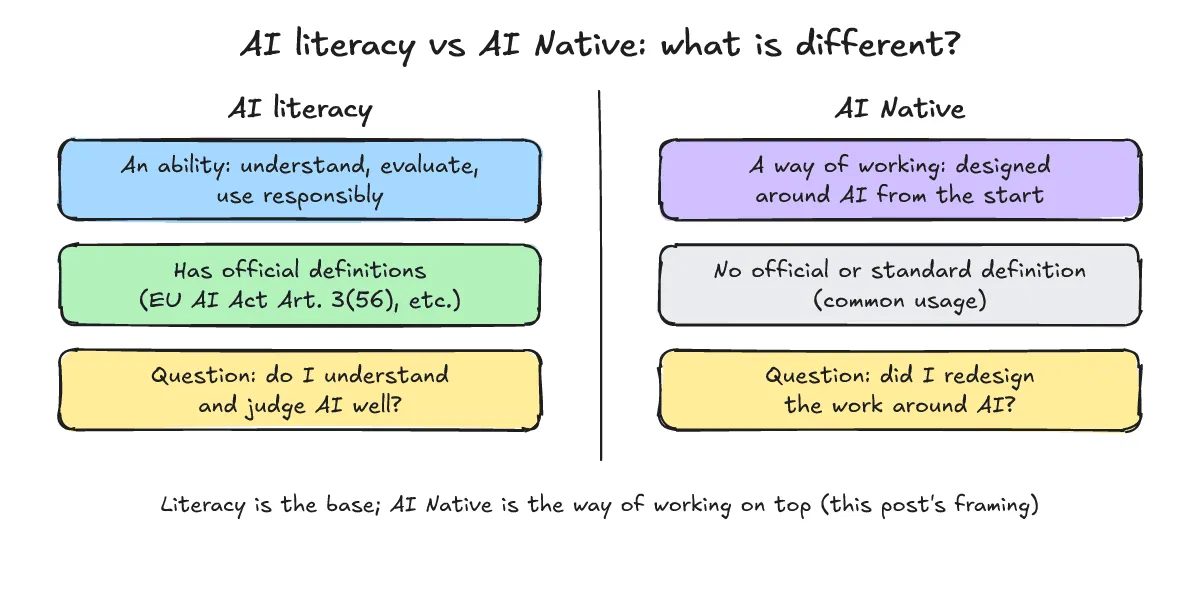
In short, the two are not competing ideas but ideas at different layers. If you change the flow around AI without understanding and judgment, unverified outputs can pass straight through; conversely, if you understand AI but leave the flow unchanged, the tool’s use stays limited. This is also the author’s interpretation.
Through what stages does AI competence grow?
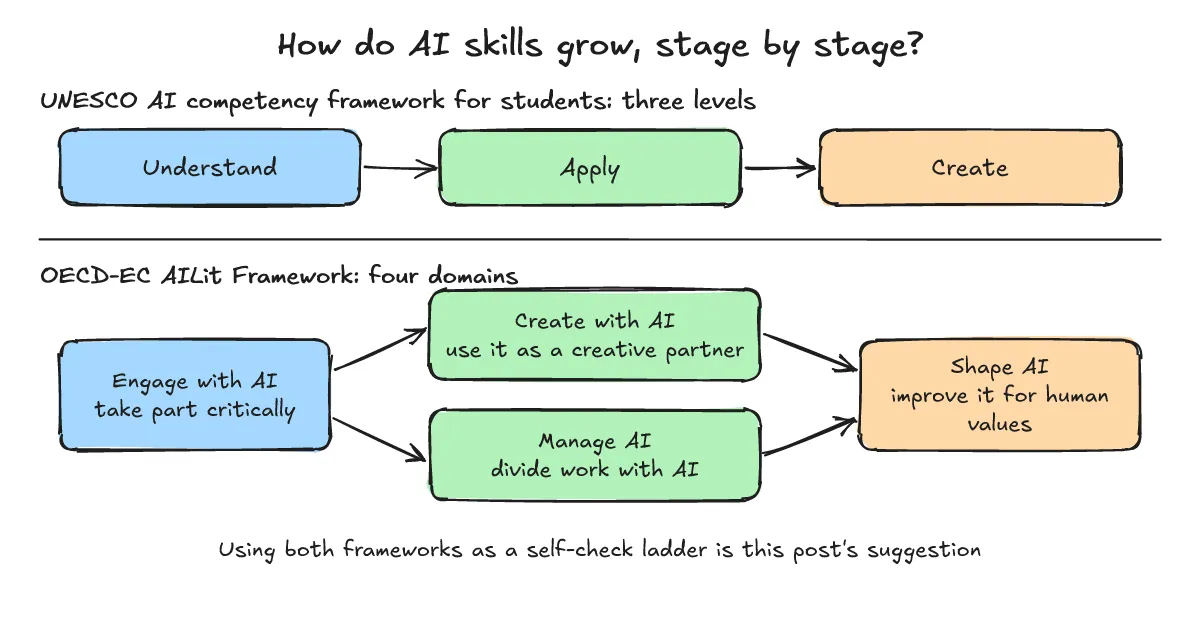
One-line answer: It progresses from understanding and evaluating AI, to creating with and managing AI through intentional task division, and finally to shaping AI responsibly.
UNESCO’s student framework says its 12 competencies span three progression levels: Understand, Apply and Create. UNESCO also publishes an “AI competency framework for teachers”, which this post mentions by name only.
The OECD and European Commission AILit Framework presents four domains sequentially as a potential learning approach. The foundation is Engage with AI: becoming a critical, responsible participant and evaluating AI outputs. Next come Create with AI and Manage AI in parallel. Create means using AI as a creative partner while keeping human agency; Manage means dividing work intentionally between humans and AI and delegating tasks. The culminating domain is Shape AI: improving AI systems so that they reflect human values. The framework also contributes to the PISA 2029 Innovative Domain.
You can use these stages as a self-check ladder, for instance by asking whether you are currently at the stage of evaluating outputs or of dividing roles. This is the author’s suggestion; the frameworks are not offered as personal diagnostic tools.
What does this look like in everyday work?
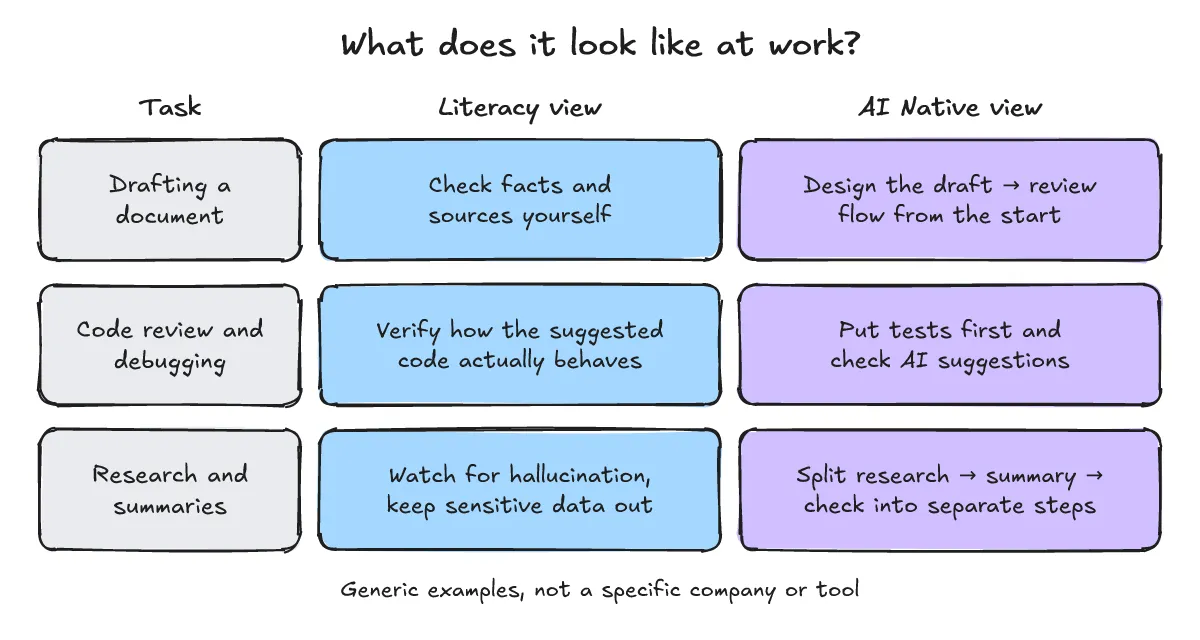
One-line answer: On the same task, the literacy lens focuses on verifying outputs and watching for risks, while the AI Native lens focuses on structuring the human–AI workflow from the outset.
Below are generic work scenes that do not depend on any specific tool or figure. The European Commission FAQ likewise says that staff who use a generative AI chatbot to write advertisement text or translate should be informed about specific risks such as hallucination.
- Drafting documents
Literacy lens: check the facts and sources in what a generative AI tool wrote, and stay alert to hallucination.
AI Native lens: design the staged flow of draft generation, review and final judgment from the start. - Code review and debugging
Literacy lens: check for yourself how the suggested code actually behaves and whether it has side effects.
AI Native lens: set the test criteria first, and structure the flow so that AI suggestions are verified against them. - Research and summarization
Literacy lens: keep the possibility of hallucination in mind and take care not to enter sensitive information.
AI Native lens: split research, summarization and cross-checking into stages and deliberately assign them to people and AI.
How can you build them?
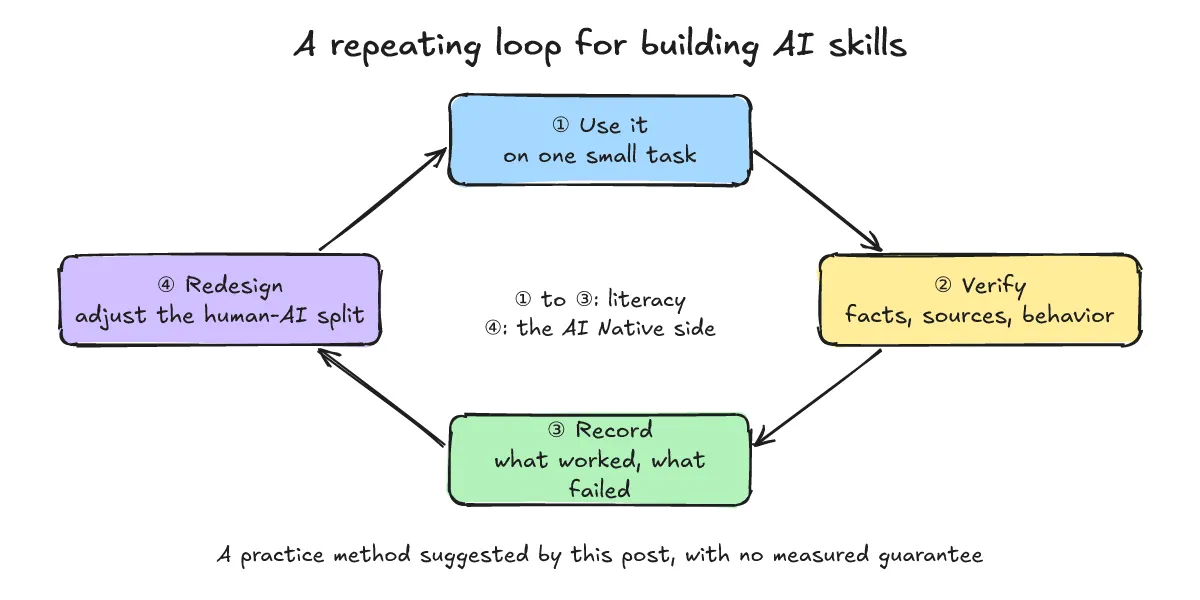
One-line answer: Build a literacy baseline through basic principles and output verification, then pick one recurring task to redesign, record, and refine how work is divided between human and AI.
The steps below are the author’s suggestions and do not guarantee any particular effect.
- Learn the basics of how AI works and how context is designed. The concepts of prompts, context and harnesses are covered in Prompt, Context, Harness, and Graph Engineering: What Is the Difference?.
- Build a habit of verifying outputs: check sources and facts, and stay aware of the risk of hallucination.
- Follow responsible-use rules, such as not entering sensitive information.
- Pick one recurring task and redesign how it is divided between people and AI. This corresponds to Manage AI in AILit.
- Record how you used AI and what you verified, then look back on it.
At the organization level, the European Commission’s “AI Literacy - Questions & Answers” lists minimum steps to consider.
- (a) A general understanding of AI in the organisation: what AI is, how it works, what AI is used, and its opportunities and dangers
- (b) The organisation’s role: whether it is a provider or a deployer
- (c) The risk of the AI systems it uses
- (d) Actions built on that analysis, considering staff knowledge and experience and the context of use
The same FAQ notes that simply asking staff to read the instructions for use may be ineffective. It also says national market surveillance authorities supervise and enforce Article 4 from 2 August 2026.
What are the frequently asked questions?
One-line answer: Rather than developer status or certificates, what matters is understanding, verification in context, and how workflows are structured.
Is AI literacy only for developers?
No. Article 4 of the EU AI Act covers staff and other persons dealing with the operation and use of AI systems, and the UNESCO and OECD–European Commission frameworks target all learners.
Do you need to code to be AI Native?
Because there is no official definition, there is no fixed requirement. It is less about whether you code and more about how you design the division of roles and the verification flow between people and AI.
Does the EU AI Act apply to companies outside the EU, such as in Korea?
According to the European Commission FAQ, it can apply to actors both inside and outside the EU, as long as the AI system is placed on the Union market, used in the Union, or its use affects people in the EU. So a company can be in scope when it is connected to the EU market or to use in the EU. This post is not legal advice; please check specific cases with a professional or the official texts.
Is a certificate required for AI literacy under Article 4?
The European Commission FAQ says no certificate is needed to comply with Article 4 and that internal records of trainings are enough. No specific governance structure, such as a mandatory AI officer, is required either.
What related posts are worth reading?
One-line answer: You can check the posts below covering context engineering concepts and foundational AI study notes.
- Prompt, Context, Harness, and Graph Engineering: What Is the Difference?
- AI basics study notes (Korean)
What are the sources?
One-line answer: Below are the regulations, international frameworks, and white papers referenced in this post.
- EU AI Act, Regulation (EU) 2024/1689, Article 3(56) — https://artificialintelligenceact.eu/article/3/ (unofficial consolidated text; official text on EUR-Lex) · checked 2026-10-24
- EU AI Act Article 4 and Regulation (EU) 2026/1744 (Digital Omnibus on AI) — AI Act Service Desk, EUR-Lex · checked 2026-10-24
- European Commission, “AI Literacy - Questions & Answers” — https://digital-strategy.ec.europa.eu/en/faqs/ai-literacy-questions-answers · checked 2026-10-24
- UNESCO, “AI competency framework for students” (2024) — https://www.unesco.org/en/articles/ai-competency-framework-students · checked 2026-10-24
- OECD–European Commission AILit Framework, “Empowering Learners for the Age of AI” — https://ailiteracyframework.org/ · checked 2026-10-24
- Ericsson White Paper, “Defining AI native” — https://www.ericsson.com/en/reports-and-papers/white-papers/ai-native · checked 2026-10-24