Key Takeaway
A C++ compiler front end processes source code through lexing, parsing, and semantic analysis (including template instantiation and constexpr evaluation) to produce a hardware-independent intermediate representation (IR or IL). In contrast, the back end takes this intermediate representation and translates it into machine code for the target CPU. This architectural separation underpins major compilers like GCC, Clang, MSVC, and EDG. EDG is particularly distinctive because its front end itself has long been its primary product. On September 30, 2026, EDG’s C++ front end source code was made publicly available under The C++ Alliance as its nonprofit home, licensed under the Apache License v2.0 with LLVM Exceptions.
The term “front end” appears frequently across the C++ tooling ecosystem. This guide explains the core differences between a compiler’s front end and back end, compares how GCC, Clang, MSVC, and EDG differ, details the official announcements regarding EDG’s open-source release, and demonstrates how to inspect your code through the compiler’s eyes using Clang AST dumps. Information from official project pages and discussions from Hacker News comments are strictly separated throughout.
What is a C++ compiler front end, and how does it differ from the back end?
Interview one-line answer: A compiler front end parses source code, validates syntax, types, and templates, and generates a hardware-independent intermediate representation (IR/IL); the back end receives this representation and generates machine code tailored to a target CPU.
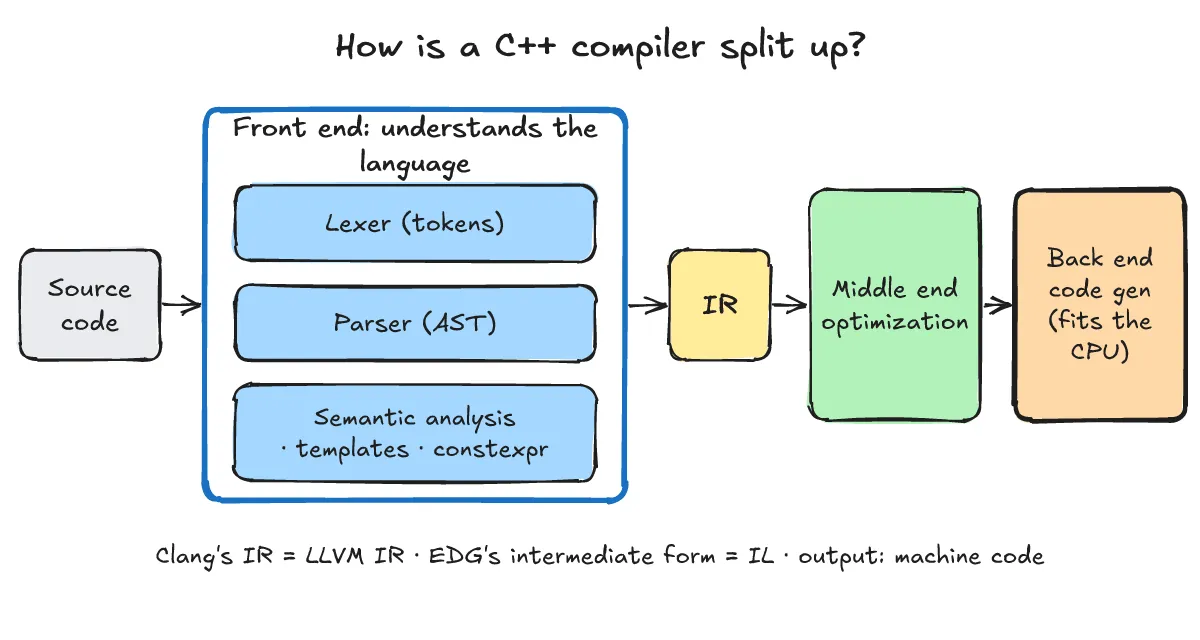
The typical compilation pipeline flows through the following stages: source code → preprocessing → front end → intermediate representation (IR) → middle-end optimization → back end code generation → machine code.
- Preprocessing: Handles preprocessor directives such as
#include,#define, and#ifdefto output clean source text. - Front end: Performs lexical analysis (tokenizing text), syntactic analysis (building an AST from tokens), and semantic analysis (type checking, name lookup, and overload resolution). In C++, template instantiation and
constexprevaluation occur during this phase. - Intermediate Representation (IR/IL): The final output of the front end. Clang generates LLVM IR, whereas EDG emits its proprietary IL (Intermediate Language).
- Middle end and back end: Applies hardware-agnostic optimizations, followed by code generation tailored to target CPU architectures.
Decoupling the front end and back end around an intermediate representation eliminates the need to write N×M compilers for N languages and M hardware targets; instead, N front ends and M back ends suffice. Furthermore, tools that do not require machine code generation—such as IDE autocompletion, real-time diagnostics, and static code analyzers—can reuse the parser front end independently.
How do GCC, Clang, MSVC, and EDG differ?
| Compiler | Maintainer | License | Character | Notes |
|---|---|---|---|---|
| GCC | GNU Project | GPL | Full compiler featuring its own front end and back end | For C++ standard support status, see cppreference Compiler support |
| Clang | LLVM Project | Apache-2.0 with LLVM Exceptions | Front end that emits LLVM IR for the LLVM back end | According to the HN discussion, Intel moved from EDG to Clang. |
| MSVC | Microsoft | Proprietary | Full compiler featuring its own front end and back end | For standard support status, see the cppreference page above |
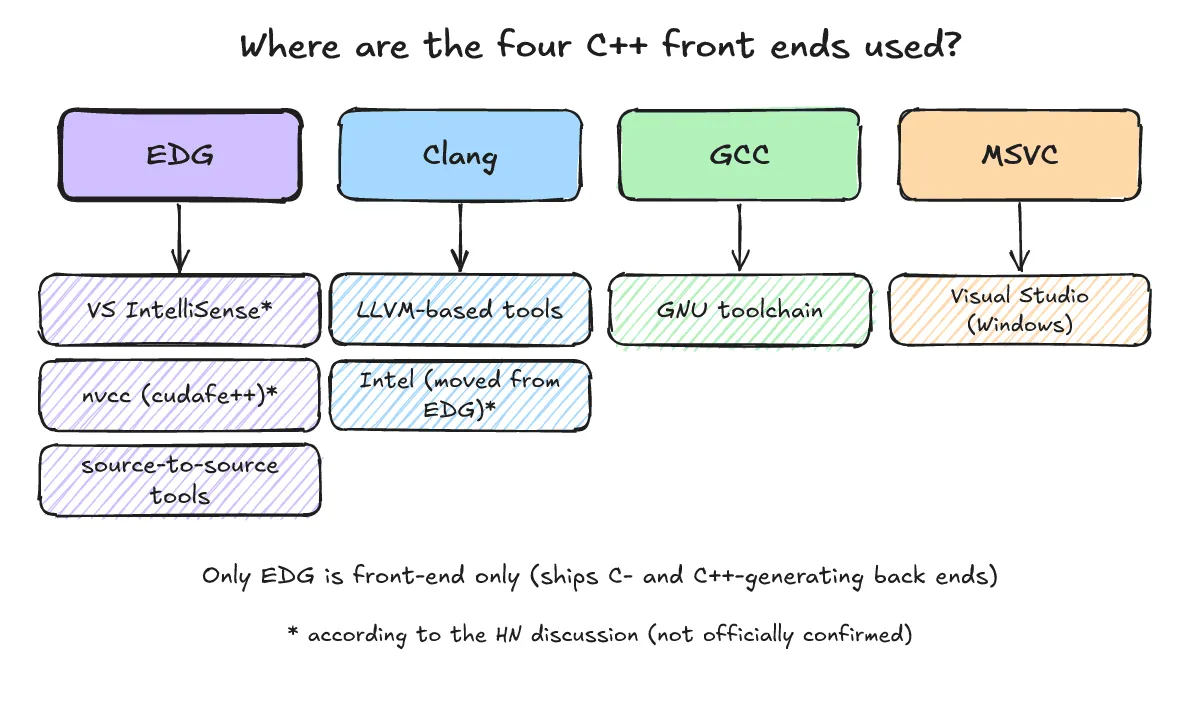
| EDG | Edison Design Group; source stewarded by The C++ Alliance | Apache-2.0 with LLVM Exceptions (since source release) | Centered on the C/C++ front end, includes back ends emitting C/C++ | According to the HN discussion, Visual Studio IntelliSense and nvcc (cudafe++) use EDG. |
Because compiler compliance levels evolve over time, this article does not make definitive claims regarding specific C++ standard coverage. Please consult the up-to-date matrix on cppreference’s Compiler support page.
- EDG’s unique positioning: The repository README states that “The EDG C/C++ front end is the primary focus of this repository.” Rather than providing a back end targeting machine hardware, it includes a C-emitting back end, a C++-emitting back end suited for source-to-source transformations, a prelinker for automatic template instantiation, utilities for reading/writing/displaying IL, and a name demangler.
- Parsing compatibility and bug emulation: According to the README, EDG is widely recognized for parse compatibility and bug emulation, ensuring that code compiling under Clang, GCC, or MSVC also compiles cleanly with EDG. It also highlights comprehensive documentation and extensive configurability.
- Notable deployments: According to the HN discussion, Visual Studio IntelliSense and NVIDIA’s nvcc front end (cudafe++) use EDG, while Intel transitioned from EDG to Clang. Because these claims originate from community comments rather than official vendor press releases, they should be viewed as contextual background. The full conversation is accessible in the Hacker News thread.
What does EDG’s open-source release mean?
- Official announcement: According to edgcpp.org, “On September 30, 2026, the source for EDG’s C++ front end went public, and The C++ Alliance became its nonprofit home.” The announcement emphasizes that “This is a change of steward, not a change of course,” noting that “For thirty years, EDG’s front end has powered C++ compilation across the industry.”
- Development and governance: Community pull requests are welcomed, maintenance is handled by Alliance EDG developers, and feature development is collectively funded. The Fiscal Sponsorship Committee is chaired by John Spicer. The repository is hosted at github.com/edgcpp/compiler.
- Licensing: The repository LICENSE.txt states that “The EDG Compiler Project is under the Apache License v2.0 with LLVM Exceptions.” Furthermore, John Spicer’s note clarifies in its FAQ that commercial use is permitted under the LLVM license, subject to its terms.
- Distinction from unverified claims: Official project materials make no mention of the company shutting down. The verified change is solely the transition from proprietary licensing fees to a nonprofit open-source stewardship model; no claims regarding corporate closure are made here.
- Community insights: According to the HN discussion, early prototypes for C++26 reflection originated from EDG developers. This reflects commentary from the forum rather than an official press release.
- Practical significance: Developers building source-to-source refactoring tools, custom linters, or static analysis engines can now directly inspect, build, and adapt an industry-proven C++ parser and C++ code-generation back end. Specific use cases and performance benchmarks are outside what was verified here, so none are claimed.
How can you inspect how the compiler sees your code?
The snippet below shows the result of running add.cpp directly with Debian clang 19.1.7. Pointers and memory addresses have been simplified to 0x....
template <typename T>
T add(T a, T b) { return a + b; }

int main() { return add(1, 2); }
clang++ -std=c++20 -fsyntax-only -Xclang -ast-dump -fno-color-diagnostics add.cppactual output (clang 19.1.7):
|-FunctionTemplateDecl 0x... <add.cpp:1:1, line:2:33> col:3 add
| |-TemplateTypeParmDecl 0x... <line:1:11, col:20> col:20 referenced typename depth 0 index 0 T
| |-FunctionDecl 0x... <line:2:1, col:33> col:3 add 'T (T, T)'
| | |-ParmVarDecl 0x... <col:7, col:9> col:9 referenced a 'T'
| | |-ParmVarDecl 0x... <col:12, col:14> col:14 referenced b 'T'
| | `-CompoundStmt 0x... <col:17, col:33>
| |   `-ReturnStmt 0x... <col:19, col:30>
| |     `-BinaryOperator 0x... <col:26, col:30> '<dependent type>' '+'
| |       |-DeclRefExpr 0x... <col:26> 'T' lvalue ParmVar 0x... 'a' 'T'
| |       `-DeclRefExpr 0x... <col:30> 'T' lvalue ParmVar 0x... 'b' 'T'
| `-FunctionDecl 0x... <col:1, col:33> col:3 used add 'int (int, int)' implicit_instantiation
|   |-TemplateArgument type 'int'
|   | `-BuiltinType 0x... 'int'
|   |-ParmVarDecl 0x... <col:7, col:9> col:9 used a 'int'
|   |-ParmVarDecl 0x... <col:12, col:14> col:14 used b 'int'
|   `-CompoundStmt 0x... <col:17, col:33>
|     `-ReturnStmt 0x... <col:19, col:30>
|       `-BinaryOperator 0x... <col:26, col:30> 'int' '+'
|         |-ImplicitCastExpr 0x... <col:26> 'int' <LValueToRValue>
|         | `-DeclRefExpr 0x... <col:26> 'int' lvalue ParmVar 0x... 'a' 'int'
|         `-ImplicitCastExpr 0x... <col:30> 'int' <LValueToRValue>
|           `-DeclRefExpr 0x... <col:30> 'int' lvalue ParmVar 0x... 'b' 'int'
`-FunctionDecl 0x... <line:4:1, col:32> col:5 main 'int ()'
  `-CompoundStmt 0x... <col:12, col:32>
    `-ReturnStmt 0x... <col:14, col:29>
      `-CallExpr 0x... <col:21, col:29> 'int'
        |-ImplicitCastExpr 0x... <col:21> 'int (*)(int, int)' <FunctionToPointerDecay>
        | `-DeclRefExpr 0x... <col:21> 'int (int, int)' lvalue Function 0x... 'add' 'int (int, int)' (FunctionTemplate 0x... 'add')
        |-IntegerLiteral 0x... <col:25> 'int' 1
`-IntegerLiteral 0x... <col:28> 'int' 2- Dependent types: Within
FunctionTemplateDecl, the binary operator+has no concrete type before instantiation and remains recorded as<dependent type>. - Implicit instantiation: When
main()invokesadd(1, 2), the front end instantiates the template, generating a concreteFunctionDeclforadd 'int (int, int)' implicit_instantiation. - Implicit casts: Semantic analysis inserts an
<LValueToRValue>cast for the parameters and adds a<FunctionToPointerDecay>node at the call site.
Shall We Check Your Understanding With a Q&A?
Q1. What is the difference between -fsyntax-only and -Xclang -ast-dump?
A1. When running with -fsyntax-only alone, Clang produces no output and exits with code 0 if the source is free of errors. Adding -Xclang -ast-dump instructs the Clang front end to dump the complete AST it constructed. This flag combination is documented in Clang’s official Introduction to the Clang AST guide.
Q2. How can I inspect compiler output without using a local terminal?
A2. You can use Compiler Explorer to write C++ directly in your browser and inspect generated assembly, ASTs, and diagnostics across a wide selection of compilers.
Q3. How does an AST dump differ from source-level template expansion?
A3. An AST dump reveals the internal abstract syntax tree nodes (declarations, expressions, type decays, and implicit casts). If you wish to inspect template-instantiated results reconstructed as clean C++ source code, a source-to-source transformation tool is more suitable.
Q4. Why do IDEs and static analyzers only require the compiler front end?
A4. Features such as autocompletion, real-time lint diagnostics, and go-to-definition rely exclusively on the syntax tree, symbol table, and type resolution. They do not require code generation or binary assembly for a target processor architecture.
Related reading:
C++ Insights란?
std::move란?