Summary
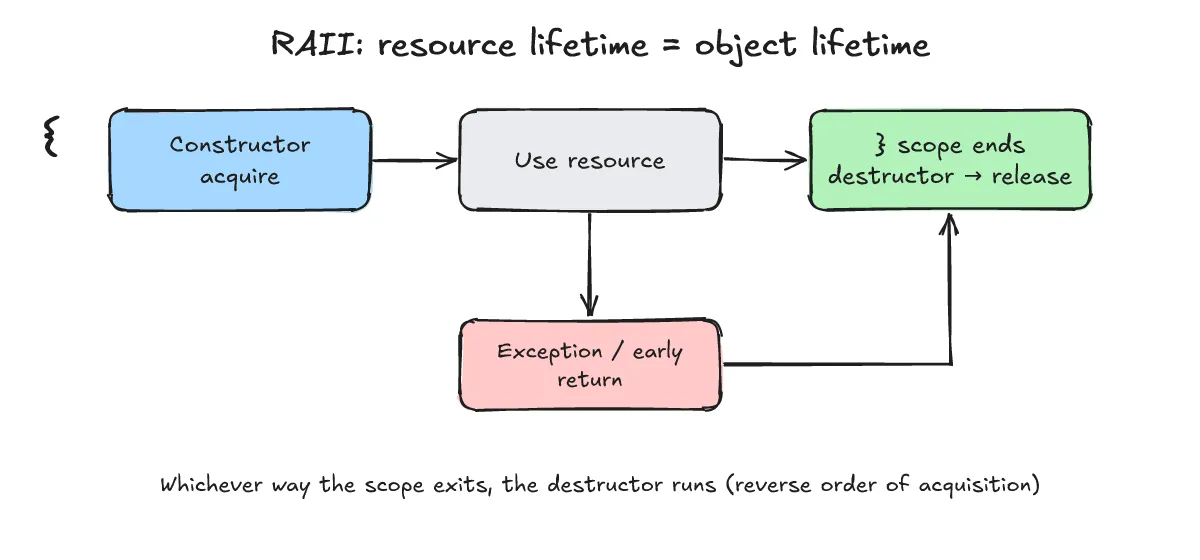
C++ RAII (Resource Acquisition Is Initialization, also called Scope-Bound Resource Management or SBRM) is a C++ technique that binds the life cycle of a resource that must be acquired before use—such as allocated heap memory, a thread of execution, an open socket, an open file, or a locked mutex—to the lifetime of an object (cppreference RAII). Because the constructor acquires the resource (or throws on failure) and the destructor releases it without throwing, all resources are automatically released in reverse order of acquisition when the controlling object’s lifetime ends, whether through normal scope exit, an early return, or stack unwinding during an exception.
What is C++ RAII, and what does binding resource lifetime to object lifetime mean?
One-line answer: C++ RAII ties a resource that must be acquired before use to an object with automatic (or temporary) storage duration, so its constructor acquires the resource and its destructor releases it in reverse order of acquisition when the scope ends.
- Definition and alias: According to cppreference, C++ RAII “binds the life cycle of a resource that must be acquired before use (allocated heap memory, thread of execution, open socket, open file, locked mutex, …) to the lifetime of an object.” It is also known as Scope-Bound Resource Management (SBRM).
- Core rules and mechanism:
- Constructor: Acquires the resource or throws if acquisition fails. If a constructor throws, already fully-constructed members and bases are released in reverse order of initialization.
- Destructor: Releases the resource and never throws.
- Storage duration: Always use RAII via an object with automatic storage duration or temporary lifetime, relying on C++ object lifetime, scope exit, order of initialization, and stack unwinding.
- Release order: Releases all resources when the controlling object’s lifetime ends, in reverse order of acquisition.
- Where RAII does not apply: RAII does not apply to resources that are not acquired before use, such as CPU time, network bandwidth, or stack memory.
- To prevent unintended implicit conversions on single-argument RAII constructors with
explicit, see our C++ explicit guide.
Actual output (g++ (Debian 14.2.0-19) 14.2.0, g++ -std=c++17 -Wall -o raii raii.cpp && ./raii)
#include <cstdio>
#include <mutex>
#include <stdexcept>

struct Guard {
    const char* name;
    explicit Guard(const char* n) : name(n) { std::printf("acquire %s\n", name); }
    ~Guard() { std::printf("release %s\n", name); }
    Guard(const Guard&) = delete;
    Guard& operator=(const Guard&) = delete;
};

void work(bool fail) {
    Guard a("A");
    Guard b("B");
    if (fail) throw std::runtime_error("boom");
    std::printf("work done\n");
}

int main() {
    work(false);
    try { work(true); } catch (const std::exception& e) { std::printf("caught: %s\n", e.what()); }
    std::mutex m;
    { std::lock_guard<std::mutex> lk(m); std::printf("inside lock_guard scope\n"); }
    std::printf("after scope try_lock: %s\n", m.try_lock() ? "ok" : "fail");
    m.unlock();
}
acquire A
acquire B
work done
release B
release A
acquire A
acquire B
release B
release A
caught: boom
inside lock_guard scope
after scope try_lock: okAs the output shows, resources acquired in order A then B are released in reverse order (B then A) both on a normal return (work(false)) and when an exception is thrown (work(true)), where stack unwinding runs both destructors before the catch block executes. Likewise, once the inner std::lock_guard scope exits, the mutex is unlocked and m.try_lock() succeeds with ok.
What bugs happen when you manage resources without RAII?
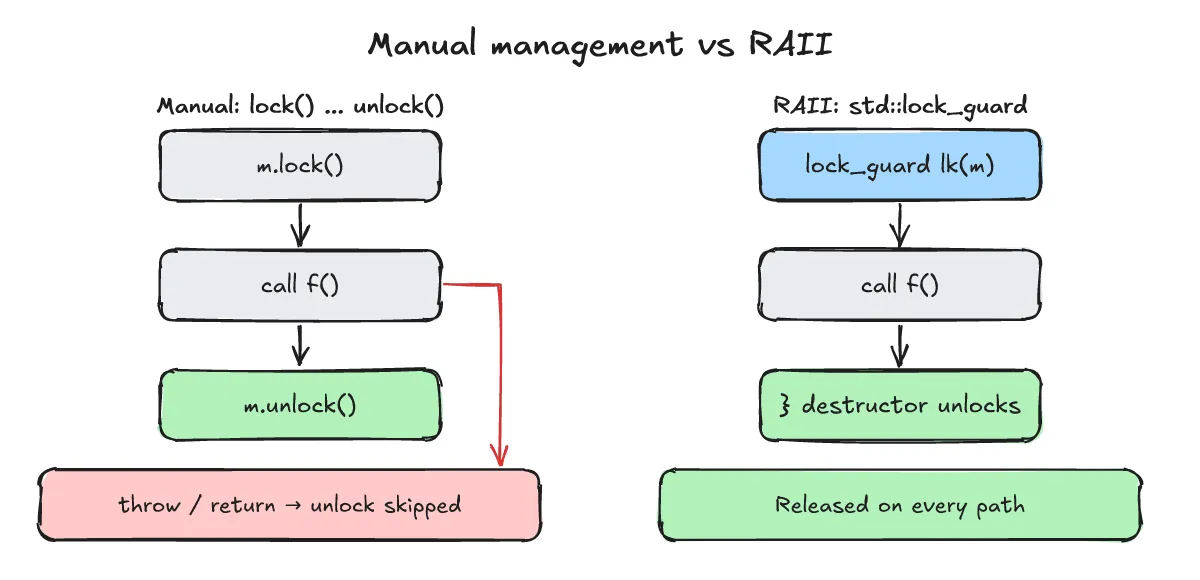
One-line answer: Relying on manual cleanup calls leads to leaked memory or files and permanently locked mutexes whenever an early return or thrown exception skips the cleanup line.
- Non-RAII patterns: Classes designed around separate
open()/close(),lock()/unlock(), orinit()/destroy()calls—or code that relies on manualdelete,fclose, orunlock—are typical non-RAII examples. - The
bad()vs.good()mutex problem: In the mutex example on cppreference, if a function locks a mutex manually and an inner callf()throws an exception or an early return occurs beforem.unlock(), the mutex is never released. Wrapping the mutex instd::lock_guardfixes this across every exit path.
When should you use standard library RAII classes?
One-line answer: Use standard library RAII containers and wrappers whenever you manage heap buffers, dynamically allocated objects, mutex locks, or file streams instead of writing manual cleanup code.
- Self-managing containers:
std::stringandstd::vectorautomatically manage their own heap buffers across their object lifetime. - Smart pointers (dynamic memory wrappers):
std::unique_ptrandstd::shared_ptr(created viastd::make_uniqueandstd::make_shared) release heap-allocated objects automatically without manualdeletecalls. - Mutex lock wrappers: Standard lock wrappers include
std::lock_guardfor single-mutex scope locking,std::unique_lock,std::shared_lock, and C++17’sstd::scoped_lockfor locking multiple mutexes without deadlock. - File streams:
std::fstreamautomatically closes its open file in its destructor. - Designing a custom RAII class: When writing your own RAII wrapper (like
Guardabove), delete the copy constructor and copy assignment operator (= delete) so two objects never release the same resource, and allow move operations if needed (see our C++ copy and move constructor guide).
Can you use RAII in embedded systems?
One-line answer: Yes—RAII requires neither heap allocation nor exceptions, because destructors of stack-allocated objects still run on every return path even in -fno-exceptions builds.
- Works without heap or exceptions: Because RAII relies on automatic storage duration and scope exit, builds compiled with
-fno-exceptionsstill run local object destructors on every function return or block exit. - Embedded use cases: You can write stack guards without heap allocation that mask and restore hardware interrupts around a critical section or restore GPIO pin states on scope exit.
Concept example (not run; register and HAL names are hypothetical placeholders)
class IrqMaskGuard {
public:
    IrqMaskGuard()  { saved_ = irq_save_and_disable(); }  // hypothetical HAL call
    ~IrqMaskGuard() { irq_restore(saved_); }
    IrqMaskGuard(const IrqMaskGuard&) = delete;
    IrqMaskGuard& operator=(const IrqMaskGuard&) = delete;
private:
    unsigned saved_;
};
void update_shared_counter() {
    IrqMaskGuard g;      // interrupts masked
    ++shared_counter;
}                        // restored on every exit path
How is RAII asked in C++ interviews?
Q1. What are the core rules of RAII (SBRM) and in what order are resources released?
Bind a resource that must be acquired before use to the lifetime of an object with automatic (or temporary) storage duration. The constructor acquires the resource (or throws), and the destructor releases it and never throws. Resources are released in reverse order of acquisition when the object’s lifetime ends; if a constructor throws, already fully-constructed members and bases are released in reverse order.
Q2. Why use RAII instead of calling open()/close() or lock()/unlock() directly?
Manual calls skip cleanup whenever an early return or exception occurs before the release call, leaking memory or files or leaving mutexes locked. RAII wrappers like std::lock_guard, std::fstream, and std::unique_ptr guarantee cleanup via their destructor on every exit path.
Q3. What should you watch out for in the copy constructor and destructor of a custom RAII class?
The destructor must never throw, and copy operations should be deleted (= delete) so two objects do not release the same resource (allow move if needed—see our copy/move constructor post; mark single-argument constructors explicit—see our explicit post).
Q4. Does RAII apply to all resources, and does it work in embedded builds without heap or exceptions?
RAII does not apply to resources not acquired before use (such as CPU time, network bandwidth, or stack memory). However, it works without heap or exceptions (-fno-exceptions builds still run destructors on return), making stack-allocated guards like interrupt-mask guards practical in embedded C++.