In one line
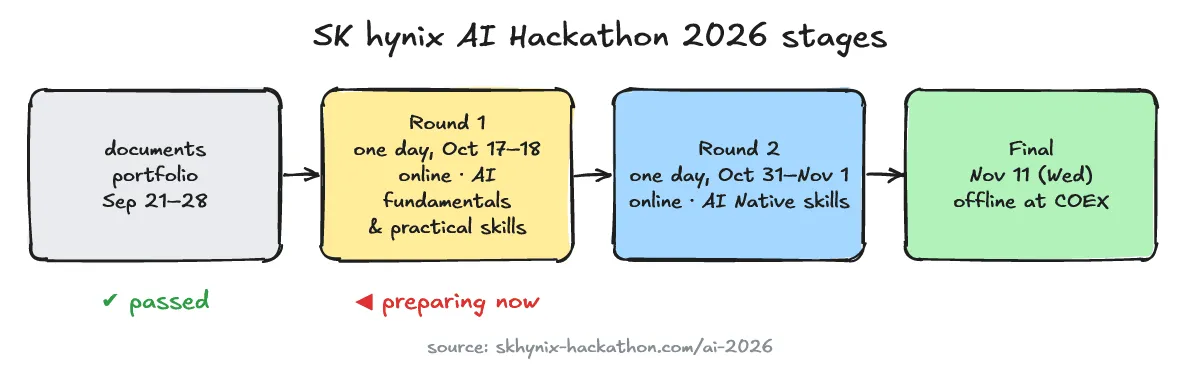
The SK hynix AI Hackathon 2026 is an individual contest where you prove your AI skills with results, regardless of education, major or years of experience. I passed the document round with a portfolio about making embedded verification unattended together with AI agents, and I’m now preparing for Round 1 in October.
What is the SK hynix AI Hackathon 2026?
It is an AI talent hackathon that SK hynix runs with LIKELION. The official site describes it as “a project to discover AI Native talent: a challenge with no conditions, proven only by results.” Anyone can apply regardless of education, major, years of experience or current employer, and it is individual participation only.
Key points from the official site:
- Core values: ZERO-BASE (unbiased evaluation), REAL BUSINESS (real problems from the field), SHOW & PROVE (prove it with results)
- Benefits: total prize money of 100 million won+, and a hiring Fast Track for top performers (exemption from the document and written (SKCT) stages)
- Applications: Sep 21 (Mon) to Sep 28 (Mon) 17:00, online application on the website plus a portfolio
- Round 1: one day between Oct 17 (Sat) and 18 (Sun), testing AI fundamentals and practical skills (online)
- Round 2: one day between Oct 31 (Sat) and Nov 1 (Sun), testing AI Native skills (online)
- Final hackathon: Nov 11 (Wed), offline at COEX
How did I apply with my portfolio?
I applied with a portfolio of my AI work. Its topic was turning embedded verification, which used to need a person sitting in front of the equipment, into an unattended verification system built together with AI agents. It was nine months of work, and it came down to three points.
- A staged agent workflow: I split the work into stages so that AI agents step in at each one, from design to failure judgment.
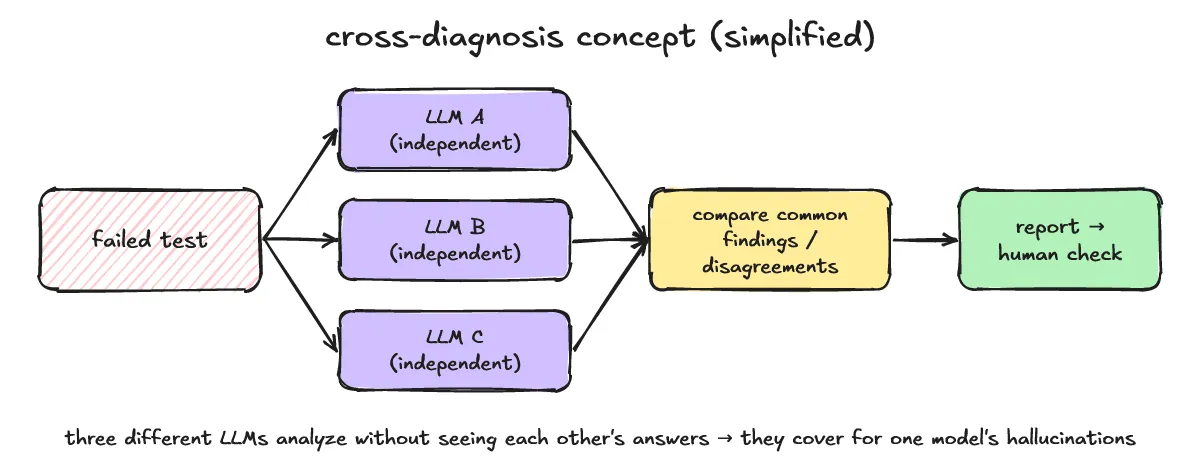
- Cross-diagnosis by three different LLMs: three models analyze each failed test separately, and comparing where they agree and disagree lets them cover for any single model’s hallucinations.
- Safeguards: changes written by AI still have to pass a regression gate, and irreversible actions go through human approval.
As a result, in a representative case, the time to reproduce an intermittent defect dropped by about 85%.
How did the document round go?
I passed the document round and advanced to Round 1. A detailed notice email is expected on October 13.
What is my resolve going into Round 1?
My goal is not AI that gives plausible answers but AI whose results can be verified. Try things fast with AI, but keep the results reproducible and verifiable. That is also why my portfolio cross-checks several models’ diagnoses and keeps a human approval step.
The Round 1 test is held on Programmers, and I expect it will mostly be problem-solving. Even so, I’m using this preparation as a chance to properly learn the LLM principles I didn’t know well, and I’m studying those principles. The AI Day series below is my record of that.
- Day1: Self-Attention
- Day2: Transformer Structure
- Day3: LLM Inference and KV Cache
- Day4: Prompt Engineering
- Day5–7: AI Limitations, Embedding and RAG Architecture, AI Agents and Tool Calling (coming soon)
Alongside the concepts, I’m also practicing log analysis with practice scenarios.
I use agents a lot at work all the time, and I’ve done a real project the AI Native way, so I think I’m prepared when it comes to how to use agents.
I really want to pass the first online round and make it all the way to the offline final.
What’s in the next post?
In the next post I’ll cover how I prepared for Round 1 and how it went, within the limits of the security pledge.