The post-task Q&A in an AI skills assessment is the stage after completing a task where candidates explain their deliverables and decision-making rationale, and the system checks whether those explanations match the actual implementation. As announced in the SK hynix Newsroom notice, the online preliminary of the SK hynix AI Hackathon 2026 plans to comprehensively evaluate problem definition, AI utilization, and result verification processes using various AI competency assessment tools such as Krafton’s AI-native recruitment and evaluation solution ‘Cofa-Probe’, showing that this type of evaluation is used in both hiring and competitions.
Summary
A post-task Q&A asks questions based on your submission and work logs, then cross-checks your explanation against the actual implementation. It mainly evaluates cognition—whether you can explain how your result works and where it can fail. Preparing comes down to recording the “why” as you work and practicing answers in the order of weakness, risk, and next verification.
What is the post-task Q&A in an AI skills assessment?
One-line answer: It is a stage that asks about your deliverable and decision rationale based on your submission, prompts, conversation logs, and verification run records, then checks whether your explanation matches the actual implementation and code locations.
According to the official Cofa-Probe page, the evaluation proceeds through four stages. First, the candidate starts in a realistic environment (01), and during the task the system automatically collects prompts, tool settings, AI conversations, and verification execution records alongside the deliverables (02). In the subsequent post-task Q&A stage (03), the candidate explains their deliverable and decision rationale, and the system verifies whether the answers match the actual implementation. This then leads into the evaluation report and interview support stage (04).
The same official page notes that the report stage cross-checks the candidate’s explanation against the actual implementation and directly checks the code and exact locations that served as the basis for decisions. Its FAQ section further states that the assessment evaluates not only how to use tools, but also the ability to define problems, delegate work to AI, and verify and explain the results.
An article by reporter Kim Pyeong-hwa at MoneyToday similarly reports that after the task ends, candidates go through a post-task Q&A explaining their deliverables and decision-making process, which the system synthesizes into evaluation results and an interview reference report.
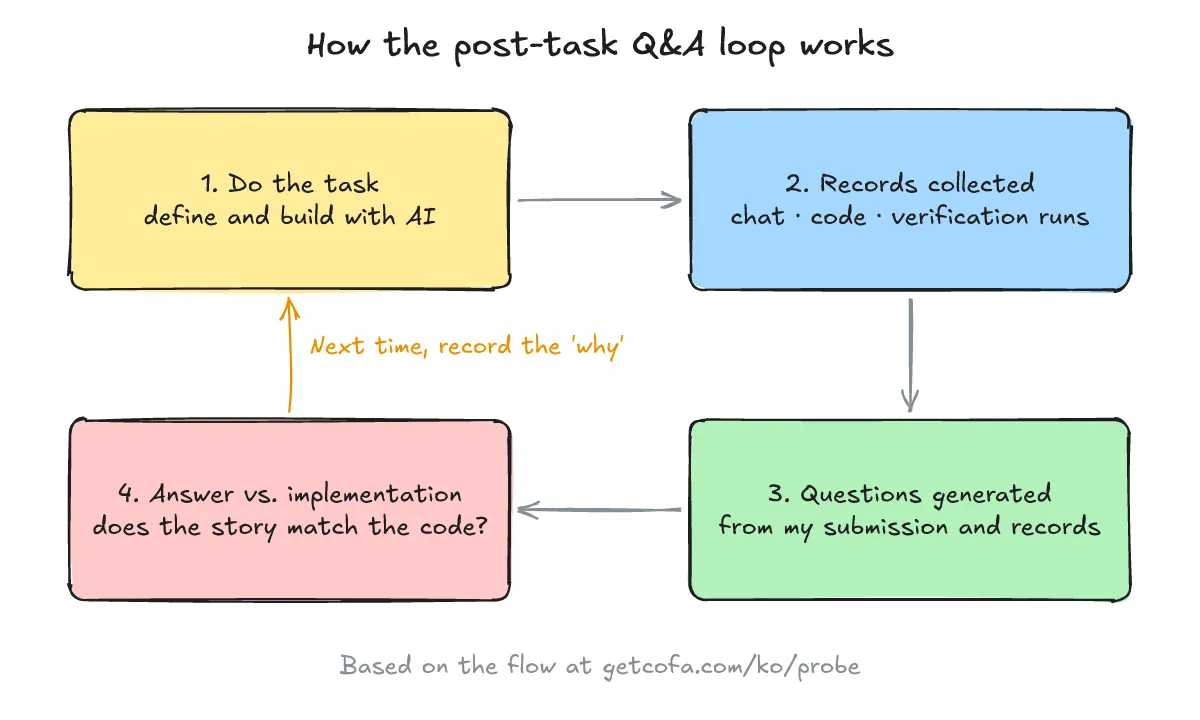
Among technique, intent, and cognition, which axis is the post-task Q&A closest to?
One-line answer: Among the three evaluation axes, it is closest to cognitive management, which checks whether you can explain how your deliverable works and where it could fail based on your own output.
The official Cofa-Probe page states that it examines deliverables, source code, prompts, work logs, and the post-task Q&A together, judging candidates by the criteria of technique, intent, and cognition and recording the evidence in the report. According to the MoneyToday article, this solution was applied on July 30 at ‘Cofathon: AI Native Battlegrounds’ co-hosted by Krafton and CJ Olive Young at PUBG Seongsu, looking across three axes—Technique, Intent, and Cognition—to see whether the candidate accurately communicated goals and constraints to AI, directly verified and modified AI-generated results, and can explain how the results work and how they might fail.
Among those three axes, examining whether a candidate can explain working principles and failure possibilities corresponds to cognitive management. In a public review of that event on brunch (Krafton FDE Cofathon Review), author Luka likewise defines cognitive management as whether you can explain why it has this structure, how it operates, and where it breaks based on your own deliverable, noting that according to the author it was the lowest axis across all participants in that event.
What kinds of questions actually appeared in a public review?
One-line answer: According to a public review of Cofathon, questions generated on the spot from the participant’s submission asked why a specific part was built that way and how the participant would respond if a failure occurred.
According to author Luka’s public review of that event on brunch (Krafton FDE Cofathon Review), after submitting the task in that event, participants answered follow-up verification questions generated on the spot from their deliverables.
The example questions cited by author Luka included asking why a specific part was built that way and how the participant would respond if a failure occurred. Sharing a personal impression of that session, the author remarked that it was genuinely difficult to explain things coherently. Even when features are built quickly with an AI coding tool, answering logically on the spot is difficult unless you have digested the internal structure and failure-handling behavior of your own output.
How should you prepare for a post-task Q&A?
One-line answer: In my view, five habits help: logging one-line decision reasons as you work, answering in weakness-risk-next verification order, flagging fallback values, leaving test and commit records, and correcting mismatched question premises first.
The following recommendations are my own opinion. Practicing these five habits during everyday tasks makes it much easier to give explanations that match your actual implementation during a post-task Q&A. For background on how unrecorded decisions turn into debt when working with agents, see Three debts of handing work to an AI coding agent.
- Log a one-line “why I did it this way” in
DECISIONS.mdat each step: Whenever you make an implementation choice, write a single line inDECISIONS.mdnoting what you chose and why. When the task finishes, you can recall your rationale immediately without relying on memory alone. - Answer in the order of weakness → risk → next verification: In the brunch review, author Luka observed that the model answers the system prepared for the verification questions always followed the same sequence: pointing out a concrete weak spot in one’s own code, explaining the ripple effect of why it is dangerous, and presenting a plan for what to verify and improve next. Rather than hiding limitations, practice stating the weakness, the resulting risk, and the follow-up verification plan in order.
- Distinguish fallback or estimated values from real results (for example, with a flag column): When inserting fallback or estimated values to handle missing data or errors, separate them clearly from normal results using a dedicated flag column. Making dropped or substituted data explicit makes your design choices straightforward to explain.
- Leave verification evidence in test runs and commit logs: As stated on the official Cofa-Probe page, the system automatically collects verification execution records. Instead of only eyeballing outputs, running tests and leaving clean commit logs provides concrete evidence that backs up your explanation.
- If a question’s premise differs from your actual implementation, state that first: As the official page notes, the post-task Q&A checks whether your answer matches the actual implementation and cross-checks your explanation against the code. If a question assumes something different from what your code actually does, do not play along with a false premise—clarify how your code is actually implemented first.
What does a practice answer example look like?
One-line answer: It states the decision and rationale first, followed by the implementation’s limitation (weakness), its potential impact (risk), and the next verification and improvement plan.
Below is my own practice example illustrating how to structure an answer around the principles above.
Example question: “Why did you handle the sensor temperature value -9999 that way?”
“I judged -9999 to be a missing-value marker the sensor writes when it fails to read, not a real temperature. So I excluded it from the average, added an is_missing flag to those rows, and stated in the report how many rows were dropped. The weak point is that other outliers, such as a momentary spike, are not filtered. Such values could pull the average up and distort the report’s conclusion. Next, I would confirm the normal range with the person who owns the data and add tests for out-of-range values.”
This response follows a clear four-part structure: first the decision and rationale (treating -9999 as a missing-value marker, excluding it from the average, and recording an is_missing flag and dropped-row count), then the weakness (other outliers like momentary spikes are not filtered), the risk (those values could pull the average up and distort the conclusion), and finally the next verification (confirming the normal range with the data owner and adding out-of-range tests).
What is the core takeaway for preparing for a post-task Q&A?
One-line answer: More than a polished output alone, the core is being able to explain why you made each decision and how you verified it, backed by your code and work records.
An AI coding tool makes it fast to produce working output, but an assessment checks whether the candidate genuinely understands the reasons behind their code choices and where the implementation’s limits lie. Rather than focusing only on the final deliverable, building the habit of leaving concise decision notes and verification records as you work is the most reliable way to prepare.
What are the frequently asked questions?
One-line answer: Here are quick answers on checking tool rules during the Q&A, keeping decision notes concise, and responding when you do not know an answer.
Can I use an AI coding tool when answering the post-task Q&A?
As a general principle, rules vary from one assessment to another, so always check and follow the official instructions provided for the specific assessment you are taking.
Does leaving too many notes hurt rather than help?
In my view, writing long paragraphs takes valuable time away from implementation. Keeping each entry in DECISIONS.md to a single line—what you chose and why—is enough to jog your memory during the Q&A without slowing you down.
What should I do if I get a question I do not know how to answer?
In my opinion, you should avoid guessing or bluffing. Because the post-task Q&A cross-checks your explanation against the actual implementation, it is better to state honestly what you have not verified yet, explain what risk that leaves open, and describe how you would verify it next.
What related posts are worth reading?
One-line answer: Check out these related posts on the three debts of working with AI coding agents and on prompt, context, harness, and graph engineering concepts.
- What are the three debts of AI coding agents? Technical, intent and cognitive debt, and habits that reduce them
- Prompt, Context, Harness, and Graph Engineering: What Is the Difference?
What are the sources?
One-line answer: This post references the official Cofa-Probe page, a MoneyToday article, a public Cofathon participant review, and the SK hynix Newsroom announcement.
- Official Cofa-Probe page: https://www.getcofa.com/ko/probe (checked 2026-10-27)
- MoneyToday (Reporter Kim Pyeong-hwa), Krafton Field-Tests AI Collaboration Assessment Solution ‘Cofa-Probe’, 2026-08-28 (checked 2026-10-27)
- Luka, Krafton FDE Cofathon Review, brunch, 2026-08-02 (checked 2026-10-27)
- SK hynix Newsroom, AI Hackathon 2026 (checked 2026-10-27)