I’ve gathered everything I’ve studied so far into a single post. It includes concept summaries, common pitfalls, the step-by-step approach for problems involving documents and data with AI, and even the mistakes I repeatedly made during practice. I organized it so that tomorrow morning, all you need to look at is this post and the links at the very bottom.
Contents
- How to Use This Post (30–40 mins in the morning)
- One-Page Core Concept Summary
- 10 Common Pitfalls (O/X)
- Problem-Solving Summary for Document & Data AI Tasks
- My Mistake Checklist
- Wrap-Up and Related Posts
How Should You Use This Post? (30–40 mins in the morning)
| Time | Task |
|---|---|
| 0–10 mins | Read 2. One-Page Core Concept Summary from start to finish. Say the comparison points marked with ★ out loud once each. |
| 10–15 mins | Solve 3. 10 Common Pitfalls. Cover the answers, decide O/X first, and then check. For anything you miss, go back to Section 2 and review. |
| 15–25 mins | If you have time left, pick and re-solve only the topic questions you got wrong in Practice Questions Part 1 or Part 2. Locking down what confused you is better than solving lots of new problems. |
| 25–35 mins | Read 4. Problem-Solving Summary for Document & Data AI Tasks, and point out the role of each line in the prompt example. |
| 35–40 mins | Read 5. My Mistake Checklist. Just recall these checkboxes when you are actually solving the problems. |
💡 Don’t try to learn anything new in the morning. This is time to organize what you already know so it’s easy to retrieve.
How Can the Core Concepts Be Summarized on One Page?
I’ve written down only the confusing comparison points for each topic. ★ marks topics that were especially easy to mix up.
① Temperature · Top-p ★
- Lowering temperature makes the distribution sharper so probability concentrates on the #1 token, making answers consistent. Raising it flattens the distribution, making answers more diverse (and increasing odd answers).
- Temperature sets the shape of the distribution, while top-k and top-p set the range of candidates.
- top-k keeps a fixed number of candidates. top-p keeps candidates until their cumulative probability reaches p, so there are fewer candidates when the distribution is sharp and more when it is flat.
- Calculation example: If probabilities are 0.50 / 0.30 / 0.10 / 0.06 and top-p = 0.85, the cumulative sum goes 0.50 → 0.80 → 0.90, so up to the 3rd token where it first exceeds 0.85, leaving 3 tokens.
② Prefill · Decode · KV Cache ★
- Prefill processes the prompt all at once, so it is compute-bound.
- Decode generates tokens one by one. For each token, model weights and the previous tokens’ K and V must be read again from memory, making it memory-bound. That’s why high-bandwidth memory like HBM is important.
- KV Cache stores and reuses only K and V from previous tokens. Q is not reused and is newly created for each new token.
- As the response gets longer, Decode steps increase and response time slows down. As context gets longer, the KV Cache also grows.
③ Supervised · Unsupervised · Reinforcement Learning ★
- Grouping similar items without labels is clustering (unsupervised).
- With labels, predicting a number is regression, and predicting a category (yes/no, spam or not) is classification. Both are supervised learning.
- Learning through trial and error while receiving rewards is reinforcement learning (games, robotics, RLHF).
- Pitfall: “Yes/no on whether it will rain” may look like a number problem, but it is classification.
④ Overfitting · Data Leakage ★
- Overfitting means the training score is high but the new-data score is low (training 99%, new data 60%).
- When training loss keeps decreasing while validation loss starts rising again, that’s a sign of overfitting. Stopping at the point where validation loss was lowest is early stopping.
- Ways to reduce it are adding more data, regularization, and early stopping. Making the model larger and training longer on little data actually makes it worse.
- Data leakage is when information from the evaluation side leaks into training, making the evaluation score falsely high. Example: preprocessing the entire dataset first before splitting it.
⑤ Zero-shot · Few-shot · CoT vs. Fine-Tuning · LoRA ★
- Zero-shot, few-shot, and CoT only change the input. The weights stay the same. So if you want the same format in a new session, you must include the examples again.
- Fine-tuning (SFT) further trains the weights using instruction–response data.
- LoRA freezes the original weights and trains only small adapters. Saying “LoRA changes all of the original weights” is false.
- If the output format is inconsistent, try few-shot first. Training comes after that.
⑥ Hallucination
- Hallucinations happen because an LLM doesn’t look up facts—it probabilistically predicts a plausible next token.
- Ways to reduce it include RAG, search tools, source verification, and cross-checking. Raising temperature goes in the opposite direction.
- Saying “If you don’t know, say you don’t know” helps, but it isn’t perfect. You must pair it with verification.
⑦ Embedding · Vector DB · RAG
- Embedding turns text into meaning vectors, a Vector DB stores and searches those vectors, and the LLM generates the final answer.
- RAG is the overall approach of retrieving documents and putting them into the Context. A Vector DB is not required. Retrieving via keyword search or web search is still RAG.
- If the inserted documents are wrong or outdated, you will get a wrong answer even with RAG.
- One-hot vectors always have a cosine similarity of 0 between different words.
⑧ LLM · Workflow · Agent
- The dividing line is not whether tools are used, but who decides the next action. If a human predefines the sequence, it’s a Workflow; if the LLM decides on its own, it’s an Agent.
- “Search at 9 AM every day → summarize → email” is a Workflow.
- Agent safeguards: grant only the minimum necessary permissions, and require human approval before irreversible actions like deleting or sending.
⑨ Self-Attention (Q · K · V)
- Library analogy: Q is the search query, K is the book label, and V is the book content.
- Scores are made by comparing Q and K, while what actually gets mixed is V.
- Example: If the Softmax result is B 0.7 and C 0.3, the new representation is 0.7·V(B) + 0.3·V(C).
⑩ Transformer
- Self-Attention is a meeting where tokens share information with each other, while FFN is individual work where each token processes information on its own.
- Attention looks at all tokens at once and doesn’t know their order. That’s why Positional Encoding is added.
- The processing order is Text → Token → Token ID → Embedding Vector.
⑪ Quantization ★
- Weight memory = number of parameters × bytes per parameter. FP16 is 2 bytes, INT8 is 1 byte, and INT4 is 0.5 bytes.
- Calculation example: Quantizing a 7B model to INT4 gives 7 billion × 0.5 bytes = 3.5GB. Changing a 13B model from FP16 to INT8 reduces it from 26GB → 13GB.
- Because Decode is memory-bound, quantization—which reduces the bytes to read—has a big impact.
- Quantization lowers the numerical precision of the same model, whereas knowledge distillation trains a new smaller model.
⑫ Pre-training → SFT → RLHF
- The order is Pre-training → SFT → RLHF.
- Pre-training is self-supervised learning because the text itself serves as the answer.
- In RLHF, humans don’t write answers; they rank multiple responses. A reward model is built from those rankings, and the model is tuned with reinforcement learning.
- DPO trains directly on preference data without the reward model and reinforcement learning stages.
⑬ Tokens · Context Window
- Token count is not equal to character count or word count. Even for the same meaning, it varies by language.
- Invisible reasoning tokens in reasoning models also count toward output usage.
- When exceeding the context window, trim, split, or summarize before sending.
⑭ MoE ★
- A router selects only a subset of experts for each token. Only the selected experts perform computation.
- Even so, all experts’ weights must be loaded in memory. Computation decreases, but memory does not.
- A load-balancing auxiliary loss is used so tokens don’t pile up on a single expert.
- Sparse models actually tend to be more vulnerable to overfitting.
⑮ Prompt · Context Engineering, System Prompt
- The scope widens in the order: Prompt ⊂ Context ⊂ Harness.
- Context engineering is choosing all the information the model sees. Example: instead of pasting the entire file every time, holding only the file path and having the model read it when needed.
- The system prompt persists throughout the session, and the longer it is, the less room remains for conversation.
- When a long session starts forgetting earlier rules, summarize only the decisions made and move to a new session.
⑯ Recall · Precision ★ (Supplement)
- Recall = true positives caught ÷ total actual positives. Look at this “when you must not miss cases” (disease screening, defect detection).
- Precision = true positives caught ÷ total predicted positives. Look at this when you want to reduce false alarms.
- Calculation example: If you catch 80 out of 100 actual defects and mistakenly flag 40 normal items as defective, Recall = 80 ÷ 100 = 0.80, Precision = 80 ÷ 120 ≈ 0.67.
- With 10 defects and 990 normal items, predicting “normal” for everything gives 99% accuracy, but Recall is 0%.
⑰ Knowledge Distillation (Supplement)
- Having a small model (student) learn to mimic the outputs of a large model (teacher) creates a small and fast model.
- Like quantization, it is a model compression method, but distillation differs in that it trains a model anew.
⑱ 4D: Four Competencies for Working with AI (Supplement)
- Delegation: Decide what to hand over to AI and what to do yourself.
- Description: Clearly communicate the goal, context, and format.
- Discernment: Verify AI outputs rather than trusting them blindly.
- Diligence: Take responsibility for the results and uphold ethics and transparency.
Can You Get These 10 Common Pitfalls Right with O/X?
Cover the answers with your hand and decide O/X first.
1. If you want to get the exact same answer every time, raise the temperature.
Answer
→ X. You must lower it so probability concentrates on the #1 token and answers stay consistent. Raising it increases variety.
2. top-p always leaves the same number of candidates.
Answer
→ X. That’s top-k. With top-p, the number of candidates changes depending on the shape of the distribution.
3. Because the Decode stage is compute-bound, increasing GPU cores speeds it up the most.
Answer
→ X. Decode is memory-bound. Memory bandwidth helps most directly. The compute-bound stage is Prefill.
4. KV Cache stores and reuses all of Q, K, and V from previous tokens.
Answer
→ X. It stores only K and V. Q is generated anew for each new token.
5. Grouping unlabeled customer data into similar groups is supervised learning regression.
Answer
→ X. It is unsupervised learning clustering. Regression is when labels exist and you predict a number.
6. Once you provide few-shot examples, the model learns that format and follows it in the next session too.
Answer
→ X. Few-shot only changes the input. The weights remain unchanged, so you have to provide the examples again next time.
7. You must have a Vector DB to do RAG.
Answer
→ X. Retrieving via keyword search or web search and putting the results into the Context is still RAG.
8. If it uses tools, it’s an Agent; if it doesn’t, it’s a Workflow.
Answer
→ X. The criterion is who decides the next action. Workflows use tools too.
9. Since MoE computes only a subset of experts per token, unused experts don’t need to be loaded in memory.
Answer
→ X. Only a subset is computed, but since you don’t know which expert will be picked, all of them must be kept in memory.
10. Quantizing a 7B model to INT4 makes its weight memory about 3.5GB.
Answer
→ O. 7 billion × 0.5 bytes = 3.5GB. (FP16 is 14GB, INT8 is 7GB)
How Do You Solve Document & Data AI Problems?
This is the method for problems where you give the AI a policy document and multiple data files to determine judgments, counts, and amounts. The detailed version is in the Strategy Post.
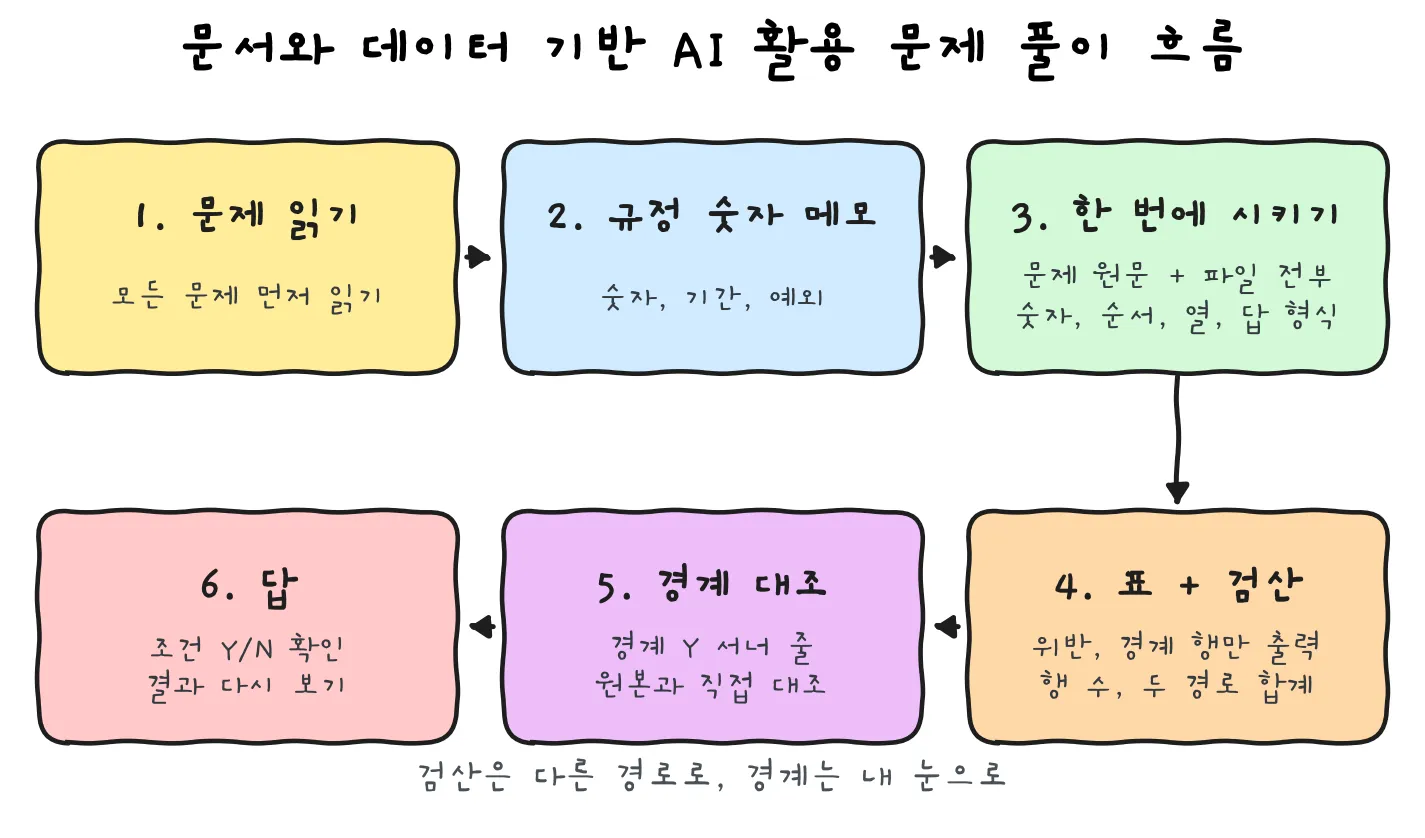
Approach Order
- Read all the questions first. See which question uses which file and what calculations overlap.
- Note down only the policy numbers, periods, and exceptions. Limits, cutoff times, effective periods, and exclusions.
- Write a single prompt that instructs everything at once. Group questions that make the same judgments on the same files.
- Get the table and verification checks.
- Cross-check boundary rows against the original data.
- Double-check the conditions and write down the answers.
One-Turn Prompt Formula
Exact original question text → Attach all required files → Policy numbers and boundary rules
→ Processing order → Table columns → Verification checks → Final line answer format- Paste the original question text as-is without summarizing. A single word like “excluding”, “more than”, “at least”, or “provided that” changes the answer.
- Attach all required files right from the start.
- Write policy numbers directly into the prompt. Include boundary rules too, such as “A value equal to the limit is not a violation.”
- Use direct imperative phrasing. Instead of “A table is needed” (note-taking tone), write “Create a table with the columns below” (command tone).
| Note-Taking Tone (X) | Command Tone (O) |
|---|---|
| Must judge according to the policy | Judge whether each row is a violation using the attached policy. |
| Organizing into a table is needed | Create a table with the columns below. |
| Request any data if needed | (Do not include. I already know what is needed.) |
Reducing Output
- Have the AI judge all rows.
- In the table, receive only violation rows and boundary rows, and get only the count for the rest.
- The longer the output, the easier it is to misread a single line in the middle of a long table.
4 Verification Checks
| Check | Sentence to Include in the Prompt |
|---|---|
| Row count | “Verify that original row count = excluded rows + remaining rows.” |
| Formula column per row | “In each row, write out the exact formula: actual work = clock-out − clock-in − break.” |
| Two-path total | “Calculate the sum by date and the sum by employee separately and verify they match.” |
| Condition Y/N | “List all conditions from the question again and mark Y/N for whether the answer satisfies each one.” |
⚠️ Adding the same numbers again is not verification. If you re-add values that are already wrong, it will naturally say “They match.” True verification means re-attaching the original files and recalculating via a different path.
Boundary Case Checklist
- ☐ A value exactly equal to the threshold (‘more than’ vs. ‘at least’)
- ☐ The first and last day of a period
- ☐ Times crossing midnight
- ☐ Duplicate submissions
- ☐ Amended or canceled entries
- ☐ Exceptions (excluded job groups, special work arrangements)
- ☐ Whether the new rule or old rule applies on the effective date itself
- ☐ How break time is handled during holiday work
Have the table include a Boundary Y/N column, and visually cross-check three or four rows marked Boundary Y directly against the original data.
Short Prompt Example (Hypothetical Travel Expense Policy)
[Attached: policy.pdf, employee_master.xlsx, travel_records.csv]
Inspect all 40 travel_records entries and answer the three questions below.
(Paste exact original question text here)
Violation criteria: ① Daily allowance > 100,000 ② Lodging > 80,000 ③ Sat/Sun AND prior_approval=N. Values equal to the limit are not violations.
Violation amount: ①② amount exceeding the limit, ③ full amount.
Order: Match department by employee ID → Judge each entry → Table.
Table for violation and boundary rows only: |EmpID|Dept|Day|DailyAllowance|Lodging|PriorApproval|Violation①②③|ViolationAmountFormula|BoundaryY/N|
For the rest, write only the count.
Verification: Violations + Non-violations = 40, sum of violations by dept = total violation count, re-verify Y/N per condition.
Final line: Q1=N cases / Q2=N KRW / Q3=DeptName
Even written briefly, every step of the formula is included.
What Mistakes Did I Repeat?
These are mistakes I actually made multiple times during practice. Recall them in this order when solving problems.
Before Sending
- ☐ Did I paste the question conditions verbatim without summarizing? (I once dropped an exclusion condition while summarizing)
- ☐ Did I attach all required files? (I once missed a file or sent with 0 files attached)
- ☐ Do sentences use direct commands like ‘Judge…’, ‘Create…’, ‘Calculate…’? (No ‘must be…’ note-taking tone)
- ☐ Did I write the policy numbers and boundary criteria directly in the prompt?
- ☐ Did I write the verification checks specifically? (Row count, formula column, two-path total, condition Y/N)
- ☐ Did I leave out open-ended setup prompts like ‘Request any data if needed’?
- ☐ Did I include the final line answer format?
Before Wrapping Up
- ☐ Did I directly cross-check boundary rows against the original? Especially the effective date itself, unreflected amendments, and break times on holiday shifts.
- ☐ Did I avoid copying down an answer where the AI said ‘Cannot be verified’ as-is?
- ☐ Did I review the Y/N check for each condition?
- ☐ Did I double-check the final result? Even a correct calculation is no use if it gets changed while you copy it over.
Through the 4D Lens, My Weakest Area Was Discernment
Looking back at my practice through the 4D framework, Delegation and Description steadily improved, but Discernment was the weakest. Whenever the AI said “Verification results match,” I just believed it. Going forward, here is what I’ll do.
- Re-attach the original files. If you verify by looking only at the table generated earlier, you inherit any errors in that table too.
- Recalculate via a different path. Pick 2–3 entries with large amounts, have the AI recalculate them from scratch, and ask it to show only the rows that differ from the previous values.
- Check with my own eyes whether there are clues inside the AI’s answer that contradict the conditions (e.g., an excluded person included in the total).
Wrap-Up and What Related Posts Should You Read Together?
Concepts by comparison points, questions verbatim, judgments on all rows, output only violations and boundaries, verification via a different path, boundaries with my own eyes.
Related Posts