Summary
The core public information on Grok 4.8 is a sentence Elon Musk posted on X on 2026-09-14: a “2.5T model trained with our new C++ software stack” that “will finish training this week and start RL.” No model card, benchmarks, pricing or release date have been published. As of the check on 2026-10-19 (KST), neither the official xAI news page nor the API model list includes Grok 4.8; the newest main model is Grok 4.7. This post covers a rough estimate of what 2.5T parameters mean in memory, what the RL stage generally means, and general reasons for a C++ stack.
What is officially known about Grok 4.8?
One-line answer: Just two posts from Elon Musk on X. No model card, parameter breakdown, benchmarks, pricing or release date has been published.
- Post 1 (X post, 2026-09-14 10:24 KST / 2026-09-14 01:24 UTC): Replying to @techdevnotes, who asked “Apart from Grok 4.7, what are we even expecting from SpaceXAI in september”, Musk wrote:
- “Grok 4.8, which is a 2.5T model trained with our new C++ software stack, will finish training this week and start RL”
- Post 2 (X post, 2026-09-14 20:19 KST): “Grok 4.8 will be a noticeable improvement.”
- Not known: There is no official model card, no word on whether it is dense or MoE, and no benchmarks, price or release date. There is also no official confirmation that training actually finished that week.
How big is 2.5T parameters in memory?
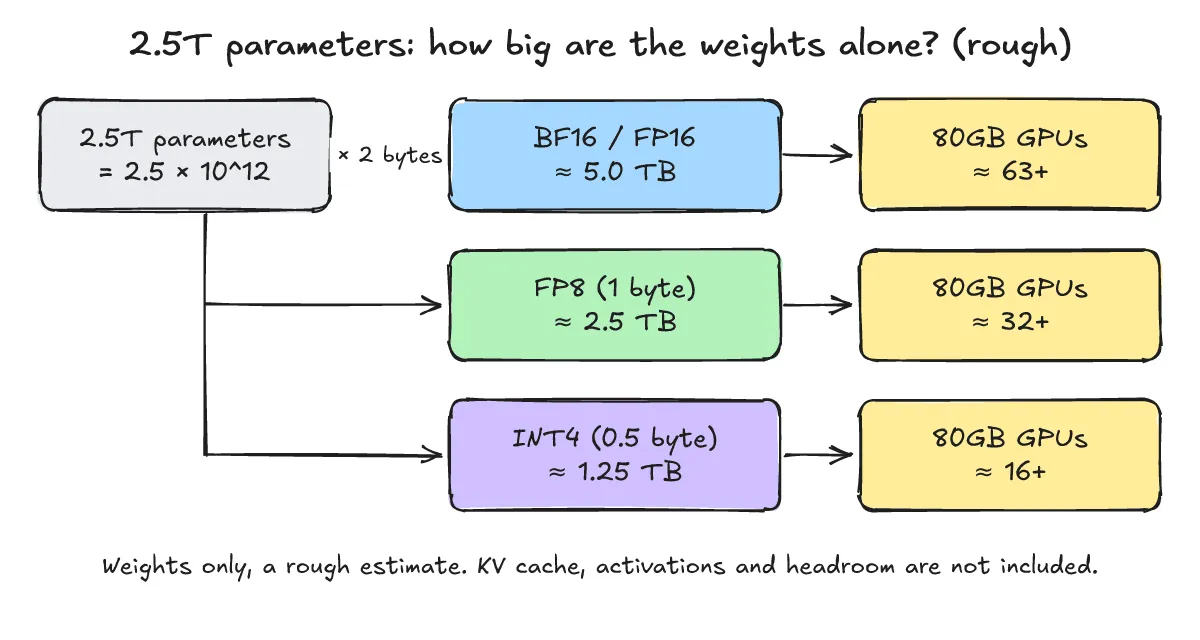
One-line answer: As a rough estimate, the weights alone are about 5 TB in BF16, needing at least ~63 GPUs of the 80 GB class. Training states push that to about 40 TB.
This is a rough estimate: weights only, decimal GB, 80 GB-class GPUs. It is not xAI’s actual setup.
- 2.5T = 2.5 × 10^12 parameters
- BF16/FP16 (2 bytes per parameter): 2.5 × 10^12 × 2 B = 5.0 TB = 5,000 GB → 5,000 ÷ 80 = 62.5 → at least ~63 GPUs just to hold the weights
- FP8 (1 byte): 2.5 TB = 2,500 GB → 2,500 ÷ 80 = 31.25 → ~32 GPUs
- INT4 (0.5 byte): 1.25 TB = 1,250 GB → 1,250 ÷ 80 = 15.6 → ~16 GPUs
- These exclude KV cache, activations, framework overhead and duplication from parallelism, so real deployments need more.
- Training is much heavier. Mixed-precision Adam keeps roughly 16 bytes per parameter (fp16 weights 2 + fp16 grads 2 + fp32 master weights 4 + Adam m 4 + v 4), per the ZeRO paper (Rajbhandari et al., 2019). 2.5 × 10^12 × 16 B = 40 TB = 40,000 GB → 40,000 ÷ 80 = 500 GPUs for model states alone, before activations. This is also a rough estimate; xAI’s actual training setup is not public.
- Whether the model is MoE is unknown. If it is, all expert weights still need memory even though compute per token is lower.
- For how lower precision shrinks memory, see our quantization post.
What does “finish training and start RL” mean?
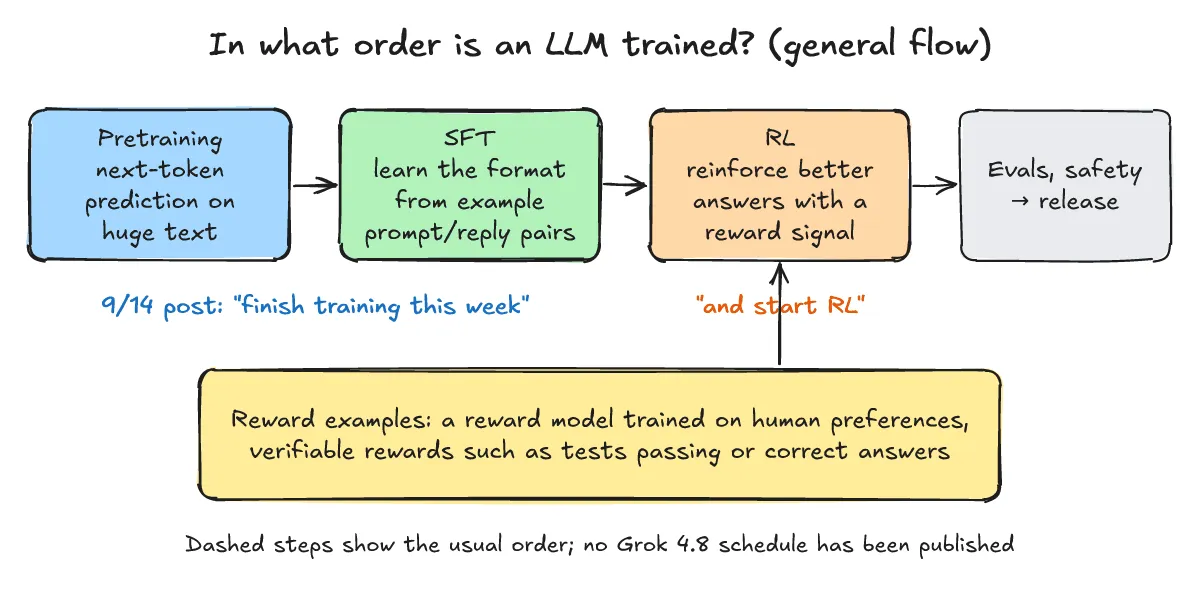
One-line answer: Generally, pretraining ends and post-training with reward signals begins. The explanation below is general background, not an xAI statement.
- Pretraining: Self-supervised next-token prediction on huge amounts of text.
- SFT: Fine-tuning on instruction–response examples.
- RL: Improving the model with rewards from preference models or verifiable rewards such as tests passing or correct math answers. RLHF uses PPO-style updates; DPO is a preference-only alternative.
- So “finish training and start RL” can be read as the pretraining phase ending and post-training beginning. A release usually comes later, after RL, evaluation and safety testing, but this too is general knowledge, not an xAI statement.
- For the difference between pretraining, SFT and RLHF, see our related post.
Why might a training stack be written in C++?
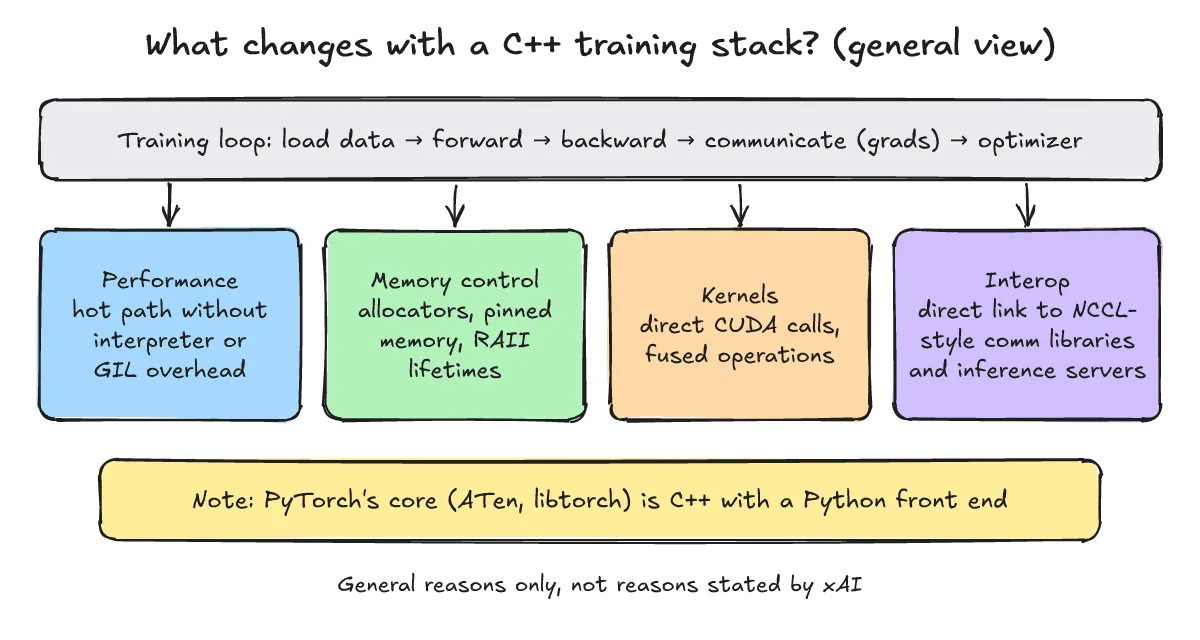
Note: What follows is general reasoning about C++ training stacks, not reasons stated by xAI. xAI has not explained its choice.
- Hot-path overhead: It avoids Python interpreter and GIL overhead on the performance-critical path.
- Precise memory control: Direct control over allocators, pinned memory and fragmentation can matter at 2.5T scale.
- Direct CUDA and kernel integration: Fused kernels are easier to integrate.
- Deterministic resource management: RAII makes resource lifetimes explicit.
- Interop: Easier integration with communication libraries such as NCCL and with inference servers.
- Note that existing frameworks such as PyTorch already have C++ cores (ATen/libtorch) with a Python front end.
Has Grok 4.8 been released as of October 19?
One-line answer: No. The official pages checked around 01:00 KST on 2026-10-19 contain no Grok 4.8 announcement.
- Check date: 2026-10-19, about 01:00 KST
- x.ai/news: The latest entry is “Introducing Grok Voice 3.0” (2026-10-14); there is no Grok 4.8 announcement.
- docs.x.ai model list: The newest text model listed is grok-4.7, with no grok-4.8. The page says “use Grok 4.7. It is the most capable model we’ve built.”
- Grok 4.7 is the latest main model, released on 2026-09-21. The independent outlet versusapp.com (2026-10-16) reports the same date.
- Release timing: No release date has been announced. Any guess would be pure speculation, so this post does not offer one.
What are the most frequently asked questions?
Q1. Has Grok 4.8 already been released?
Not as of the check around 01:00 KST on 2026-10-19. Neither x.ai/news nor the docs.x.ai model list includes Grok 4.8, and the newest main model is Grok 4.7. No release date has been announced.
Q2. Is Grok 4.8 a dense model or MoE?
Unknown. Musk’s post only says “2.5T model,” and no parameter breakdown has been published.
Q3. Has xAI said why it uses a C++ stack?
No. The post only mentions a “new C++ software stack”; every C++ reason in this article is general reasoning.
What are the sources?
- Elon Musk, X post (2026-09-14 10:24 KST)
- Elon Musk, X post (2026-09-14 20:19 KST)
- xAI News (checked 2026-10-19)
- xAI Docs: Models (checked 2026-10-19)
- versusapp.com, Grok 4.8 release date (2026-10-16)
- Rajbhandari et al., ZeRO (2019)