In one line
I tried the Programmers AI Assessment practice set and got a little over half right. I’d thought it would be easy, and it hit me that at this rate I’d fail. The problem was asking AI from the start, the way I do when coding. Now I’m preparing with one rule: “AI is the hands; I’m the head.”
This continues part 1: What Is the SK hynix AI Hackathon 2026?.
What kind of problems are in the Programmers AI Assessment?
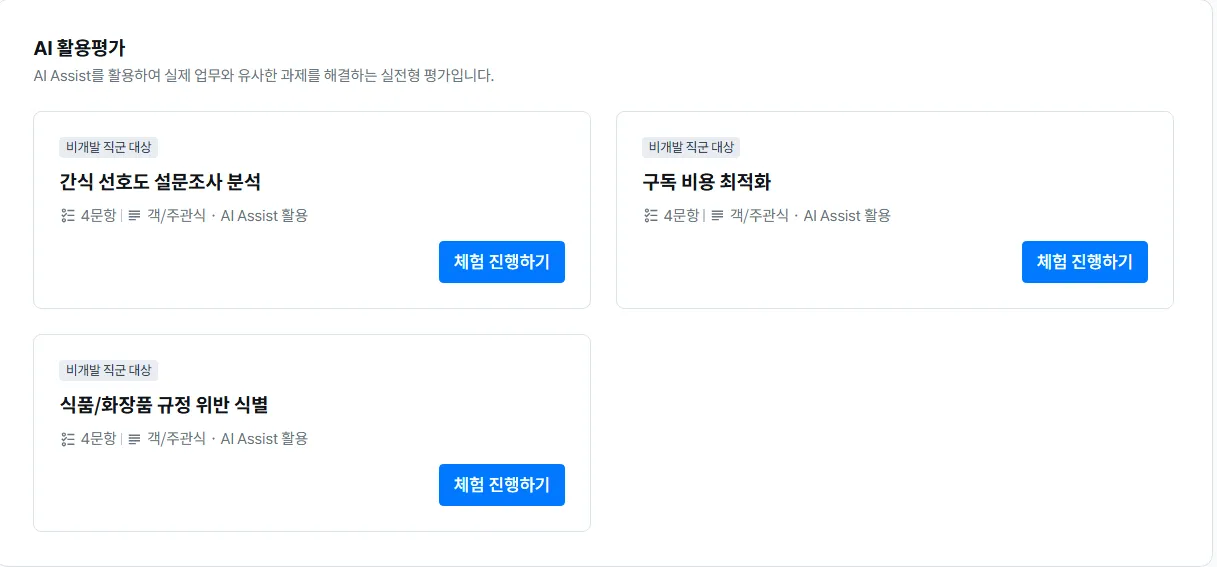
Programmers describes its AI Assessment as “a hands-on assessment where you use AI Assist to solve tasks similar to real work.” The practice list has three tasks for non-developer roles, each with 4 questions, multiple-choice/short-answer, using AI Assist.
- Snack preference survey analysis
- Subscription cost optimization
- Identifying food/cosmetics regulation violations
Below is the actual practice list screen. I won’t share the problems or answers, only the topics and how I approached them.
How did it go when I actually solved them?
It’s practice mode, so there’s no score, only correct or incorrect per question. I got 7 of the 12 questions across the three tasks right, a little over half.
- Subscription cost optimization (4 questions): 1 correct, 1 wrong, 2 not submitted. I used up the AI question allowance on the earlier questions, and on a question that one table could solve, I picked the AI’s answer as-is.
- Snack preference survey analysis (4 questions): all 4 correct, using AI only 4 of 10 times. I solved the simple parts myself, narrowed the context, gave step-by-step instructions and specified the output format. But the AI gave a self-contradictory answer, saying 13 people and then listing 16, and I let it pass without verifying.
- Identifying food/cosmetics regulation violations (4 questions): 2 of 4 correct. I picked the EU-standard document as the reference for a question about the general standard, missed one condition, and attached only some of the 45 targets.
The biggest lesson: before using AI, read the problem to the end and organize the conditions myself. AI is the hands; I’m the head.
Why do I get stuck when I use AI the way I do for coding?
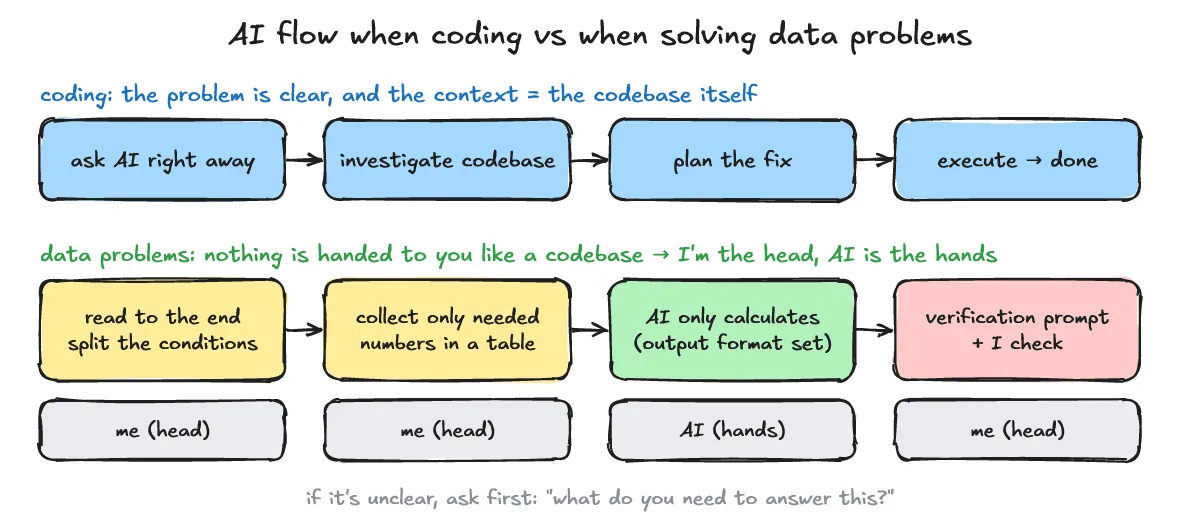
The problem was that, out of coding habit, I asked AI from the very start. In coding the problem is clear and the context is the codebase itself, so the one-click “investigate the codebase → plan the fix → execute” worked.
But these problems aren’t handed to you like a codebase. I have to understand the problem, figure out what’s needed, and decide where AI is worth using. Theory seems fine thanks to what I’ve studied and my experience using AI, but I learned I’m weak at solving problems from given materials.
How have I decided to use AI from now on?
- Think first, then delegate: read the problem, work out what has to be solved and how to use AI efficiently, and only then hand off the work. When there are several conditions, split them into ① and ②.
- Give AI processed information: practice processing information before handing it over, the way I’d write a plan document. Collect only the numbers I need into a table and have the AI only calculate.
- If I don’t get it, ask what’s needed first: when something is unclear, first ask the AI “what do you need to answer this?” so I give it the right information.
I’ve added two practical tips: split the AI question allowance across the problems in advance, and attach a verification prompt so the AI checks that its own answer is consistent.
A week to Round 1: what’s my resolve?
About a week is left until the first online test. I want to make it to the second online round, and if I get there, I’ll want to go on to the offline final too. After my interviews in the first half of the year I was left with regrets, so this time I’ll work hard and leave none. Haha.
I’m also continuing the AI study series I’ve been writing.
- Day1: Self-Attention
- Day2: Transformer Structure
- Day3: LLM Inference and KV Cache
- Day4: Prompt Engineering
- Day5–7: AI Limitations, Embedding and RAG Architecture, AI Agents and Tool Calling