MCTP (Management Component Transport Protocol) and PLDM (Platform Level Data Model) are DMTF (Distributed Management Task Force) PMCI standards used inside a server board so that a management controller (BMC) and on-board devices can exchange status and control messages. Based on DSP0236 MCTP Base Specification 1.4.0 and its companion transport binding specifications, this post explains how server device management is structured and how the MCTP transport header, Endpoint IDs (EIDs), message tags, bindings, and the bus owner work.
Summary
MCTP is a DMTF transport protocol that enables management controllers such as a BMC and on-board devices to exchange management messages inside a server board, while PLDM is the data model on top that defines “what to say.” MCTP uses the same packet format across different physical buses such as SMBus/I2C, PCIe, and I3C, and identifies devices by Endpoint ID (EID) rather than physical bus addresses. The bus owner assigns EIDs using MCTP Control messages such as Set Endpoint ID.
What are MCTP and PLDM and where are they used in server device management?
One-line answer: MCTP is the transport layer that carries messages between a baseboard management controller (BMC) and on-board devices regardless of the underlying physical bus, and PLDM is the upper-layer data model that represents management operations such as sensor readings and firmware updates.
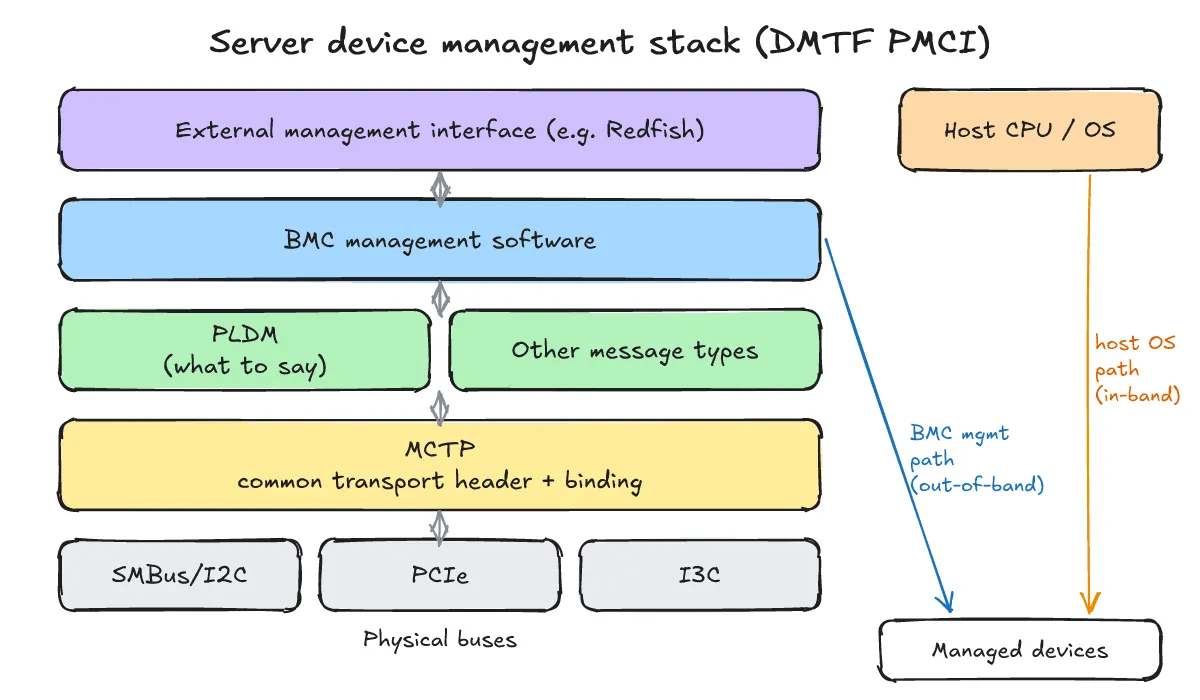
A server board includes a BMC (Baseboard Management Controller) that monitors and manages devices on the board separately from the host CPU and operating system. By separating the host OS path (in-band) from a dedicated management path (out-of-band), the BMC can monitor and manage on-board components independently of the host operating system state.
When administrators or external management tools communicate with the BMC over a network, they use external management interfaces such as IPMI or Redfish. Inside the server board, communication between the BMC and individual devices uses the DMTF PMCI (Platform Management Components Intercommunication) stack.
The PMCI stack separates transport from data modeling. At the lower layer, MCTP provides a common packet format and addressing scheme across physical buses such as SMBus/I2C, PCIe, and I3C. At the upper layer, PLDM defines the data model for “what to say” on top of MCTP, alongside other message types that can also run over MCTP. Details on individual PLDM types are covered in “What are PLDM types? Base, monitoring (PDRs and sensors), firmware update and RDE” (next in series).
What is inside the MCTP packet header?
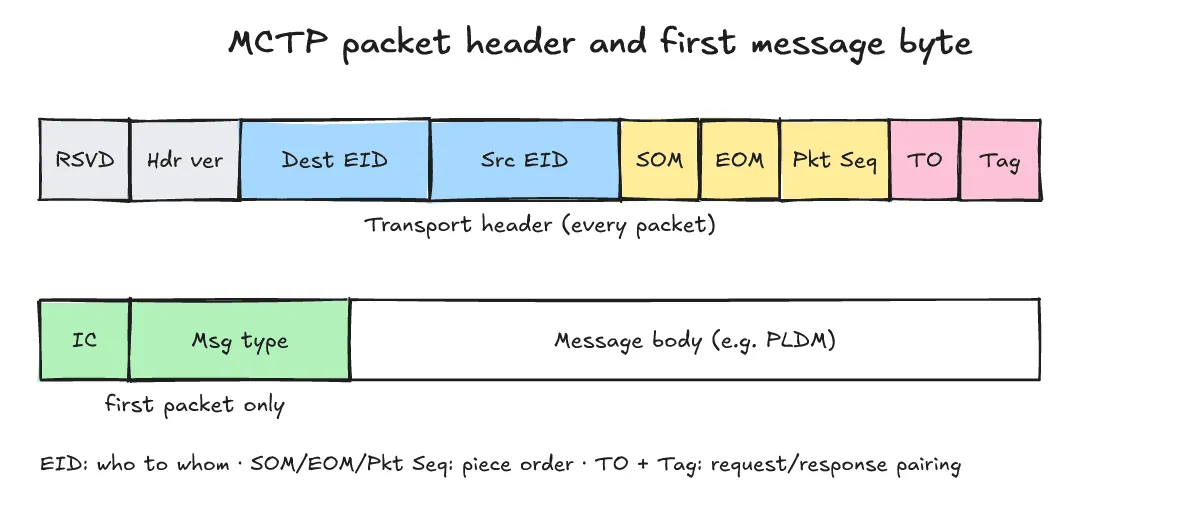
One-line answer: The 32-bit MCTP transport header contains the header version, destination and source EIDs, packet assembly flags (SOM, EOM, Pkt Seq #), and message identification fields (TO, Msg tag), followed in the first packet of a message by the integrity check bit (IC) and Message type in the first byte of the message body.
According to Table 1 of DSP0236 1.4.0, the 32-bit MCTP transport header consists of the fields listed below. As noted in the specification, the exact position of subfields may vary depending on the transport binding.
| Field | Width | Description (DSP0236 1.4.0 Table 1) |
|---|---|---|
RSVD | 4 bits | Reserved |
Hdr version | 4 bits | Header version (0001b for this version) |
Destination endpoint ID | 8 bits | Destination Endpoint ID (EID) |
Source endpoint ID | 8 bits | Source Endpoint ID (EID) |
SOM | 1 bit | Start of message flag |
EOM | 1 bit | End of message flag |
Pkt Seq # | 2 bits | Packet sequence number (increments modulo 4) |
TO | 1 bit | Tag Owner bit |
Msg tag | 3 bits | Message tag |
Immediately following the transport header, the first byte of the message body contains IC (1 bit, indicating whether a message integrity check is present) and Message type (7 bits, identifying the upper-layer payload type). This byte is required only in the first packet of a message (where SOM is set).
Why are EIDs and message tags needed?
One-line answer: An EID provides a logical address independent of the physical bus addressing scheme, while the message tag (Msg tag) and TO bit distinguish concurrent requests, responses, and multi-packet messages from the same source.
Physical buses such as SMBus/I2C, PCIe, and I3C each use different hardware addressing formats. MCTP abstracts these differences by identifying endpoints with an 8-bit logical address called an EID (Endpoint ID). Table 2 of DSP0236 defines several special EID values:
0(Null EID): Indicates that only the physical address is used.1–7: Reserved values.0xFF: Broadcast within the same bus (network-wide broadcast is not provided).
When an endpoint sends multiple messages or splits a large message into multiple packets, receivers must be able to tell which packets belong together. MCTP identifies a message using the combination of Msg tag (3 bits), TO (Tag Owner, 1 bit), and the Source endpoint ID.
DSP0236 sets the baseline transmission unit at 64 bytes. Messages larger than a single packet are segmented across multiple packets using SOM to mark the first packet, EOM to mark the last packet, and Pkt Seq # (which increments modulo 4) to ensure packets are reassembled in order.
Over which physical buses does MCTP operate?
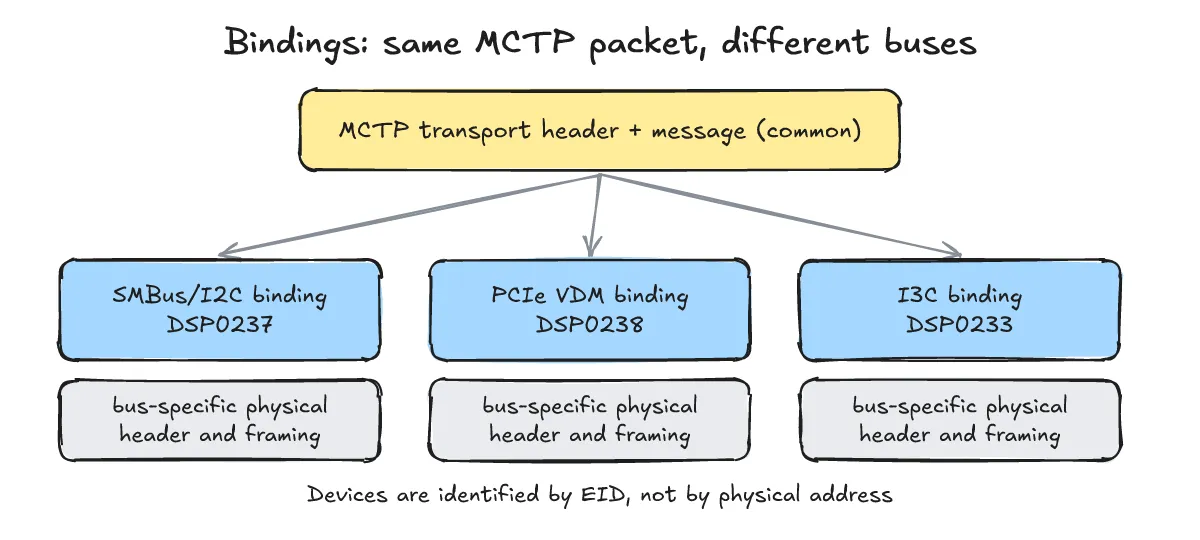
One-line answer: MCTP carries the same transport header across different physical buses such as SMBus/I2C, PCIe VDM, and I3C by letting each transport binding specification define the medium-specific framing and physical header.
While the MCTP Base Specification (DSP0236) defines the medium-independent transport header and control protocol, separate transport binding specifications define the physical-medium header and framing used to carry the MCTP header on each bus:
- SMBus/I2C binding (DSP0237): MCTP messages over SMBus use command code
0x0F. For I2C bus basics, see I2C, SPI and UART basics. - PCIe VDM binding (DSP0238): Carries MCTP packets inside PCIe Vendor Defined Messages (VDMs) using the DMTF Vendor ID
1AB4h. - I3C binding (DSP0233): Defines the DMTF transport binding specification for carrying MCTP over I3C buses.
How does the bus owner discover devices and assign EIDs?
One-line answer: The bus owner—the party that manages EID assignment on a bus—sends MCTP Control messages such as Set Endpoint ID and Get Message Type Support to identify endpoints, assign EIDs, and query available message types.
In DSP0236 terminology, the bus owner is the party that manages EID assignment on that bus. The bus owner uses MCTP Control messages to assign EIDs to endpoints and discover what protocol versions and message types each endpoint can handle. The table below lists five core Control command codes from DSP0236:
| Command Code | Command Name | Purpose |
|---|---|---|
0x01 | Set Endpoint ID | Assign or update an endpoint’s EID |
0x02 | Get Endpoint ID | Query an endpoint’s current EID |
0x03 | Get Endpoint UUID | Query the endpoint’s unique UUID |
0x04 | Get MCTP Version Support | Query available MCTP base and message type versions |
0x05 | Get Message Type Support | Query the list of upper-layer message types available on the endpoint |
DSP0236 also defines Control commands for endpoint discovery and routing, including Prepare for Endpoint Discovery, Endpoint Discovery, and Routing Information Update. When multiple buses are connected through bridges, messages are passed between buses through the bridge and routing configuration.
What are the frequently asked questions?
One-line answer: Here are answers covering other message types carried over MCTP (NVMe-MI, SPDM), why MCTP is used instead of raw I2C register reads, and how to work with MCTP and PLDM on Linux.
What message types other than PLDM run over MCTP?
According to DSP0239 1.12.0 (MCTP IDs and Codes), defined message types include 0x00 MCTP Control, 0x01 PLDM (DSP0241), and 0x04 NVMe-MI (DSP0235), and message types for SPDM and Secured Messages also exist.
Why not just read device registers directly over I2C?
Reading custom register maps directly over I2C ties management software to a specific physical bus and device register layout. Using MCTP provides a common message format and a logical address scheme (EID) independent of the physical bus, allowing the same upper-layer management software to operate across different buses such as SMBus/I2C, PCIe VDM, and I3C.
How can I try MCTP and PLDM on Linux?
Linux kernel AF_MCTP sockets, user-space tools, and PLDM libraries are covered in “How are MCTP and PLDM handled on Linux? AF_MCTP sockets, mctp, mctpd, libpldm and pldmd” (next in series).
What related posts are worth reading?
One-line answer: The following posts in this series cover PLDM message types in detail and how to use AF_MCTP and libpldm on Linux.
- “What are PLDM types? Base, monitoring (PDRs and sensors), firmware update and RDE” (next in series)
- “How are MCTP and PLDM handled on Linux? AF_MCTP sockets, mctp, mctpd, libpldm and pldmd” (next in series)
- What are common MCTP/PLDM interview questions and model answers? 19 Qs on packets, EIDs, Instance IDs, sensors, firmware update and debugging
What are the sources?
One-line answer: This post references the DMTF PMCI specifications for the MCTP base protocol, transport bindings, and message type IDs.
- DMTF PMCI standards (checked 2026-10-31)
- DSP0236 MCTP Base Specification 1.4.0 (checked 2026-10-31)
- DSP0237 MCTP SMBus/I2C Transport Binding 1.2.0 (checked 2026-10-31)
- DSP0238 MCTP PCIe VDM Transport Binding 1.4.0 (checked 2026-10-31)
- DSP0233 MCTP I3C Transport Binding 1.0.1 (checked 2026-10-31)
- DSP0239 MCTP IDs and Codes 1.12.0 (checked 2026-10-31)