Summary
Buildroot is a simple tool that builds the root filesystem and image in one pass from menuconfig/defconfig. Yocto is a large framework that manages packages and distributions with layers, recipes and bitbake. For a small product or a fast start, pick Buildroot. For multiple products, long-term maintenance or package management, pick Yocto.
One-line answer: Choose Buildroot to ship one product quickly, and Yocto when you need multiple boards and long-term maintenance.
What are Buildroot and Yocto?
One-line answer: Both build a cross toolchain, kernel, bootloader, root filesystem and the final image for a board; they differ in how they are organized.
Buildroot uses Kconfig-based configuration: you pick options with make menuconfig and save and load settings as defconfigs. Yocto is the OpenEmbedded build system driven by BitBake, organized into meta-* layers and .bb recipes.
If cross-compiling itself is new to you, start with the post What is cross-compiling? Building with ARM gcc and running it in QEMU, step by step.
How is the structure different?
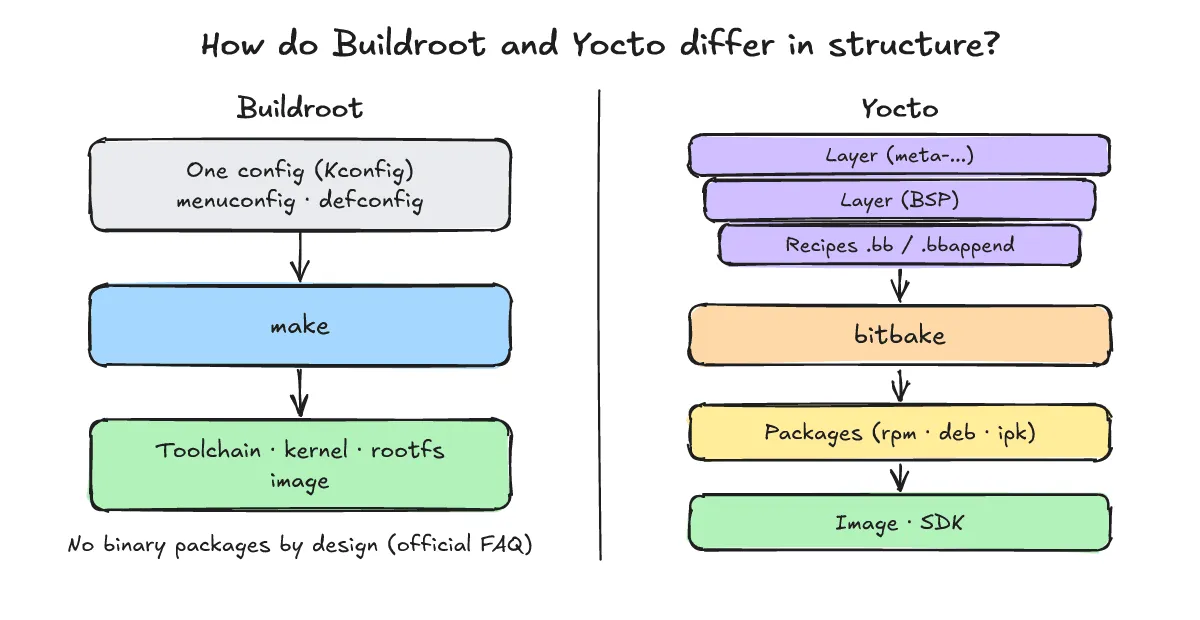
One-line answer: Buildroot goes from a single Kconfig configuration through make to an image; Yocto stacks layers and recipes and runs bitbake through packages to an image.
According to the Buildroot manual, make list-defconfigs lists defconfigs and savedefconfig saves your settings. You can build an internal toolchain or use an external one. BR2_EXTERNAL keeps project customizations outside the source tree, and make sdk generates an SDK tarball that includes the toolchain.
According to the Yocto docs, you extend functionality with layers, recipes and .bbappend files. An SDK is generally produced with populate_sdk, and package feeds are available.
Package management is where they differ most. Buildroot FAQ 11.7 explains that it deliberately does not generate binary packages (.deb, .ipkg and so on) to stay simple. In Yocto, PACKAGE_CLASSES in local.conf selects among package_rpm, package_deb and package_ipk; the first one is used for the image and SDK, and the others also generate packages.
| Aspect | Buildroot | Yocto |
|---|---|---|
| Configuration | One Kconfig (menuconfig/defconfig) | Layers + recipes + bitbake |
| Unit of customization | BR2_EXTERNAL | Layers, .bbappend |
| Binary packages | Deliberately not generated | rpm/deb/ipk via PACKAGE_CLASSES |
| SDK | make sdk | populate_sdk |
The Yocto bitbake and QEMU hands-on is covered in Yocto bitbake·QEMU hands-on. Trimming a defconfig is covered in “Minimizing a Buildroot defconfig — What to Drop, Deps, savedefconfig”.
How do build time and learning cost differ?
One-line answer: Yocto generally has the heavier first build and the steeper learning curve; Buildroot is lighter but has a full-rebuild rule you need to know.
This is a relative comparison with no measured timings. Per section 8.2 of the Buildroot manual, Buildroot does not detect which parts must be rebuilt after a configuration change. You have to know when a full rebuild is needed; for example, changing the target architecture requires a complete rebuild.
Yocto has a reuse cache (sstate) that helps later builds, but this post only touches on the concept.
Which one should I pick in which situation?
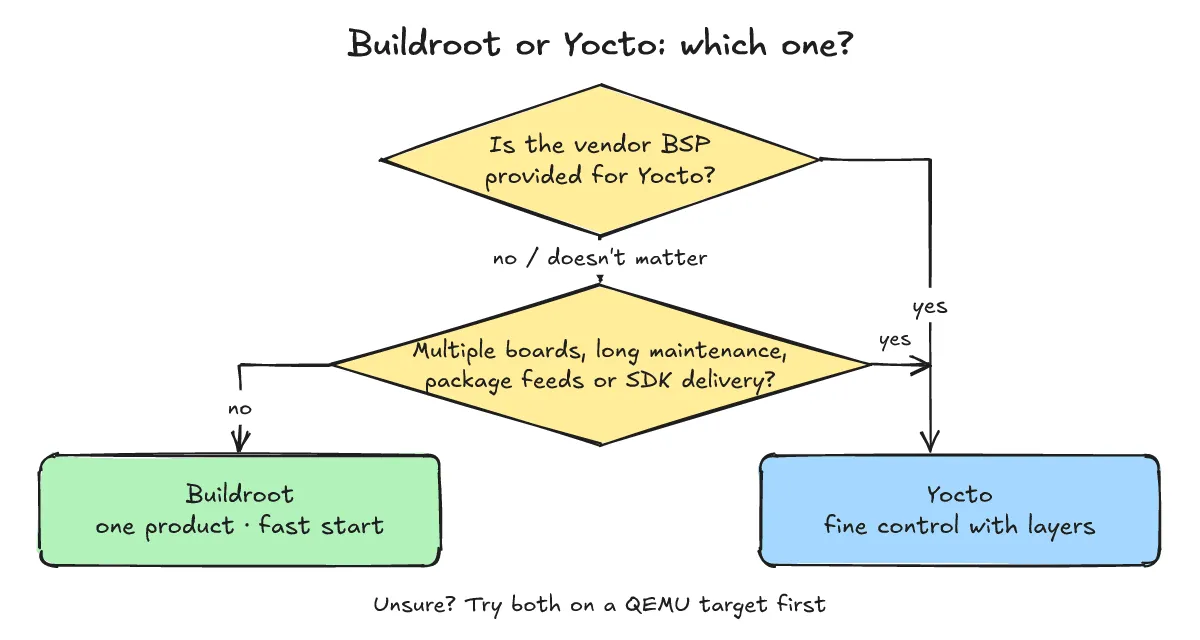
One-line answer: One product, fast start, small team means Buildroot; multiple boards, long-term maintenance, SDK and package feeds, or a Yocto-based vendor BSP means Yocto. Check the vendor BSP first.
- First check which tool the board vendor’s BSP uses. If it is Yocto-based, Yocto is the natural choice.
- One product, fast start, small team: choose Buildroot.
- Multiple boards, long-term maintenance, SDK and package feeds: choose Yocto.
For debugging memory problems on the built image, What is valgrind? Finding C/C++ memory leaks and how it differs from ASan may help.
What are the frequently asked questions?
One-line answer: Switching is possible but not automatic; checking the BSP and trying a QEMU target first are the safest starting points.
Can I switch between them?
Yes, but configurations and recipes do not convert automatically, so you need to rebuild them.
Which one does the board vendor's BSP use?
Check this first; it often decides the choice.
Can I try a QEMU target first?
Yes. Buildroot has qemu_* defconfigs and Yocto has qemu* MACHINEs. For the Yocto QEMU walkthrough, see Yocto bitbake·QEMU hands-on.
What are the sources?
One-line answer: The Buildroot manual and the official Yocto docs, checked on 2026-10-21.
Related posts
- Yocto bitbake·QEMU hands-on
- What is valgrind? Finding C/C++ memory leaks and how it differs from ASan
- What is cross-compiling? Building with ARM gcc and running it in QEMU, step by step
- Minimizing a Buildroot defconfig — What to Drop, Deps, savedefconfig